A home watch service with a law enforcement background is defined as a professional property oversight solution that applies trained investigative skills, systematic inspection protocols, and documented reporting to protect vacant homes during owner absences. The role of law enforcement background in home watch goes far beyond a simple security check. It brings a prevention-first mindset, credible documentation, and the kind of risk awareness that only comes from years of police training. For seasonal and absentee homeowners in Naples, North Naples, and Ave Maria, Florida, this distinction matters. The National Home Watch Association (NHWA) sets accreditation standards for the industry, but a law enforcement background adds a layer of professional judgment that no checklist alone can replicate.
How does law enforcement training improve home watch effectiveness?
Law enforcement training sharpens a home watch inspector’s ability to detect threats before they become crises. Police officers spend years learning to read environments, identify vulnerabilities, and document observations with precision. Those skills transfer directly to property oversight.
A law enforcement-trained inspector approaches each visit the way an officer approaches a scene: methodically, with attention to what is out of place. A slightly ajar window, a door with a compromised frame, or a gate left unlocked are details a trained eye catches immediately. An untrained inspector may walk past all three.
The practical benefits of this training include:
- Threat detection: Identifying signs of attempted entry, tampering, or surveillance activity around the property.
- Risk assessment: Evaluating structural and environmental conditions that signal developing problems, such as water stains or HVAC airflow issues.
- Documentation discipline: Recording observations with the same rigor used in police reports, producing records that hold up in insurance claims and investigations.
- Crime prevention awareness: Recognizing patterns that make a property a target, such as accumulated mail, overgrown landscaping, or visible valuables.
- Emergency communication: Knowing how to relay information to local law enforcement clearly and efficiently when an incident requires police response.
Pro Tip: Ask any home watch provider whether their inspection notes include specific observations or just a pass/fail checklist. Law enforcement-trained inspectors write narrative observations. That detail is what makes reports useful to insurers and investigators.
Private patrol services with law enforcement backgrounds produce shift reports that directly support police investigations. That level of documentation is the standard Vanguard Home Watch LLC applies to every property visit.
Police vacation watch vs. law enforcement background home watch
Many homeowners assume local police will keep an eye on their vacant property. The reality is more limited. Police vacation watch programs fluctuate entirely based on patrol district call volume and officer availability. There is no scheduled inspection, no written report, and no maintenance check.
Police vacation watch does not address property maintenance or HVAC and water failure issues. A burst pipe, a failed air conditioner in a Florida summer, or a mold outbreak will not appear on any police patrol report. By the time you return home, the damage is done.
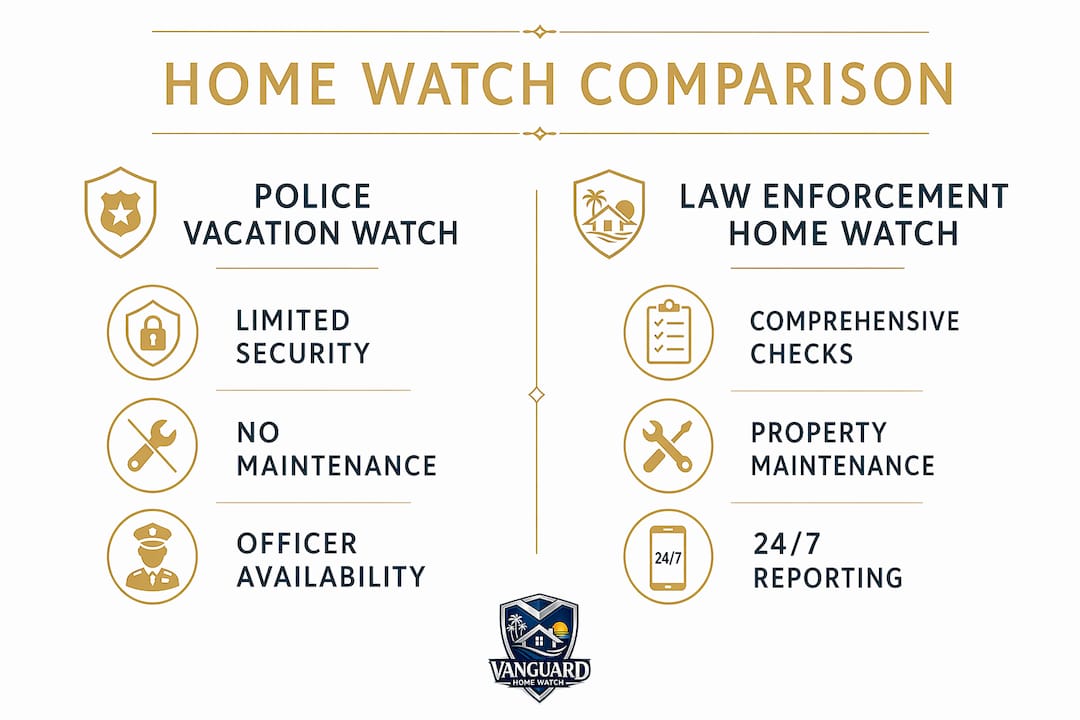
The table below shows the core differences between the two approaches:
| Feature | Police vacation watch | Law enforcement background home watch |
|---|---|---|
| Scheduling | Based on officer availability | Fixed weekly or bi-weekly visits |
| Inspection scope | Exterior security check only | Exterior and interior, including systems |
| Maintenance coverage | None | HVAC, plumbing, humidity, pest activity |
| Written documentation | None | Detailed report with photos after every visit |
| Insurance support | Not applicable | Reports usable for claims and investigations |
| Accountability | No direct contact | Owner-operated, named point of contact |
The gap is significant. A professional home watch service with law enforcement expertise fills every category that a police patrol leaves empty. Vanguard Home Watch LLC provides scheduled visits, written reports, and direct communication after every inspection.
What do law enforcement background home watch inspectors actually check?
Professional home watch inspections cover both security and property systems in a single visit. Inspection reports include photos and detailed security verification that goes well beyond confirming an alarm is armed.
A thorough inspection covers:
- Exterior perimeter: Fencing, gates, garage doors, and all entry points checked for signs of tampering or forced access.
- Doors and windows: Locks, frames, and seals inspected for integrity and weather damage.
- Alarm and security systems: Verified as active and functioning, with any alerts noted and reported immediately.
- HVAC systems: Thermostat settings confirmed, airflow checked, and condensate drain lines inspected for blockages.
- Plumbing and water: Visible pipes, water heaters, and under-sink areas checked for leaks or moisture.
- Humidity and air quality: Interior humidity levels assessed to identify mold risk before it becomes visible.
- Pest activity: Signs of insect or rodent intrusion noted and flagged for follow-up.
- Storm damage: Post-storm exterior checks for roof, screen enclosure, and landscaping damage.
Pro Tip: Request that your home watch provider deliver reports within 24 hours of each visit. Law enforcement-trained inspectors document while observations are fresh. A delayed report is a diluted report.
High-quality documentation is as important as the inspection itself. Reports with timestamped photos and written observations support insurance compliance and serve as evidence when property incidents occur. Vanguard Home Watch LLC delivers a digital inspection report with photos after every visit, giving you a clear record of your property’s condition over time.
Why does the unregulated home watch industry make law enforcement backgrounds critical?
The home watch industry is unregulated, lacking any NAICS classification, government oversight, or mandatory provider requirements. Anyone can call themselves a home watch company. That fact alone makes vetting your provider non-negotiable.
Without regulation, homeowners have no government body to turn to if a provider is uninsured, unbonded, or dishonest. The burden of verification falls entirely on the homeowner. A law enforcement background does not replace that verification, but it does signal a provider who has already been vetted, trained in ethics, and held to professional standards throughout their career.
NHWA accreditation requires insurance, bonding, background checks, and professional reporting tools. That accreditation is the industry’s strongest quality benchmark. Vanguard Home Watch LLC holds NHWA accreditation and meets every one of those requirements.
A law enforcement background adds accountability that goes beyond paperwork:
- Built-in ethics training: Law enforcement careers require ongoing ethics education and conduct standards.
- Verified background: Police officers undergo extensive background investigations before ever joining a department.
- Accountability culture: Officers operate under public scrutiny and departmental oversight for their entire careers.
- Incident response experience: Law enforcement professionals know how to respond, document, and communicate when something goes wrong.
Because the home watch industry is unregulated, homeowners must verify providers’ bonding, insurance, background checks, and accreditations directly. A provider with a law enforcement background and NHWA accreditation has already cleared the highest available bar.
How should seasonal homeowners select a law enforcement background home watch provider?
Choosing the right provider requires asking specific questions, not just reading a website. The following steps give you a reliable framework for evaluating any home watch company.
- Confirm law enforcement credentials. Ask for the provider’s specific background: rank, years of service, and department. A retired lieutenant brings different depth than someone with a brief security role.
- Verify NHWA accreditation. Check the NHWA member directory directly. Accreditation confirms insurance, bonding, and background check compliance.
- Request a sample inspection report. A quality report includes timestamped photos, written observations, and specific findings. A generic checklist is not sufficient.
- Ask about inspection frequency. Weekly visits are the standard for vacant Florida homes during the off-season. Bi-weekly may be appropriate for shorter absences.
- Clarify communication protocols. You should receive a report within 24 hours of every visit. Ask how urgent issues are communicated and what the emergency response process looks like.
- Confirm the provider personally conducts inspections. Owner-operated services mean the person you hired is the person entering your home. Subcontracted inspectors introduce accountability gaps.
- Ask about local law enforcement relationships. A provider with a law enforcement background often has direct relationships with local police. That connection accelerates response when an incident requires it.
Hiring a home watch company in Naples means evaluating credentials the same way you would vet any professional you trust with your property. The benefits of home watch service for seasonal homeowners are only realized when the provider meets a genuine professional standard.
Key Takeaways
A law enforcement background is the single most reliable indicator that a home watch provider will detect risks early, document findings credibly, and respond to incidents with professional judgment.
| Point | Details |
|---|---|
| Law enforcement training detects more | Trained inspectors identify security vulnerabilities and property issues that untrained eyes miss. |
| Police vacation watch has real limits | Local police patrols offer no scheduled visits, no maintenance checks, and no written reports. |
| Documentation protects your investment | Timestamped photo reports support insurance claims and provide evidence for police investigations. |
| Unregulated industry requires active vetting | No government body oversees home watch providers; homeowners must verify credentials directly. |
| NHWA accreditation is the quality benchmark | Accreditation confirms insurance, bonding, background checks, and professional reporting standards. |
What 25 years in law enforcement taught me about watching over homes
I spent over two decades in law enforcement before founding Vanguard Home Watch LLC with my wife Elizabeth. The most important thing that career taught me is that problems rarely announce themselves. A slow leak under a sink looks like a water stain. A compromised door lock looks like a normal door. A property under surveillance looks like a quiet street. You only catch those things if you know what to look for and you are looking with intention.
What surprises most homeowners is how quickly a small issue becomes a large one in a vacant Florida home. A failed HVAC in july does not just mean a warm house. It means humidity climbs, mold begins within 48 hours, and by the time you return in october, you are facing a remediation bill that dwarfs an entire year of home watch fees. I have seen it happen. That is exactly why we conduct weekly home watch inspections rather than monthly ones.
The homeowners who call me most relieved are not the ones who never had a problem. They are the ones who had a problem caught early. A water heater showing signs of failure, replaced before it flooded the utility room. A screen enclosure damaged by a storm, documented and repaired before the next one hit. That early detection is what a law enforcement background actually delivers. It is not a credential on a business card. It is a trained habit of observation applied to your property every single week.
— Joseph
Vanguard Home Watch LLC: professional oversight backed by law enforcement expertise
Vanguard Home Watch LLC is founded and operated by retired law enforcement lieutenant Joseph Vangelakos and real estate professional Elizabeth Vangelakos. Every inspection we conduct in Naples, North Naples, and Ave Maria follows the same disciplined approach Joseph applied throughout his law enforcement career. We are fully insured, bonded, background checked, and accredited by the National Home Watch Association. After every visit, you receive a detailed digital report with photos so you always know the condition of your home. Learn more about what a home watch inspector does and review our service frequency options to find the right fit for your property.
FAQ
What is the role of law enforcement background in home watch?
A law enforcement background equips home watch inspectors with trained observation skills, documentation discipline, and crime prevention awareness. These skills allow them to detect security vulnerabilities and property issues that standard inspectors routinely miss.
Does local police vacation watch replace professional home watch?
No. Police vacation watch provides limited security checks based on officer availability and covers no maintenance issues. Professional home watch delivers scheduled visits, interior inspections, and written reports after every visit.
Why does the home watch industry need law enforcement-trained providers?
The home watch industry is unregulated as of 2026, with no government oversight or mandatory standards. Law enforcement-trained providers bring built-in ethics, verified backgrounds, and professional accountability that the industry itself does not require.
What should inspection reports from a home watch service include?
Quality inspection reports include timestamped photos, written observations for each area inspected, and specific findings on security systems, HVAC, plumbing, and pest activity. These reports support insurance claims and provide documentation for police investigations when needed.
How often should a vacant home in Florida be inspected?
Weekly inspections are the standard for vacant Florida homes during the off-season. Florida’s heat and humidity create conditions where HVAC failures and moisture problems escalate within days, making frequent visits the only reliable way to catch issues before they cause serious damage.

