Home watch reporting is defined as a structured, documented visual inspection of a vacant or seasonal property, delivered as a timestamped, photo-supported digital report after every scheduled visit. The National Home Watch Association (NHWA) recognizes this process as the professional standard for absentee property oversight, and many insurance carriers now require it to validate vacancy clauses. Understanding exactly how this process works, what it covers, and why it differs from a neighbor stopping by gives you the clarity to protect your property investment with confidence.
What does the home watch reporting process involve step by step?
The home watch reporting process begins before a single inspection takes place. Initial property assessment and profile creation typically take around 60 minutes and establish the baseline condition of your home. During this walkthrough, your provider documents the property’s systems, notes any pre-existing conditions, and sets the standard against which every future visit is measured.
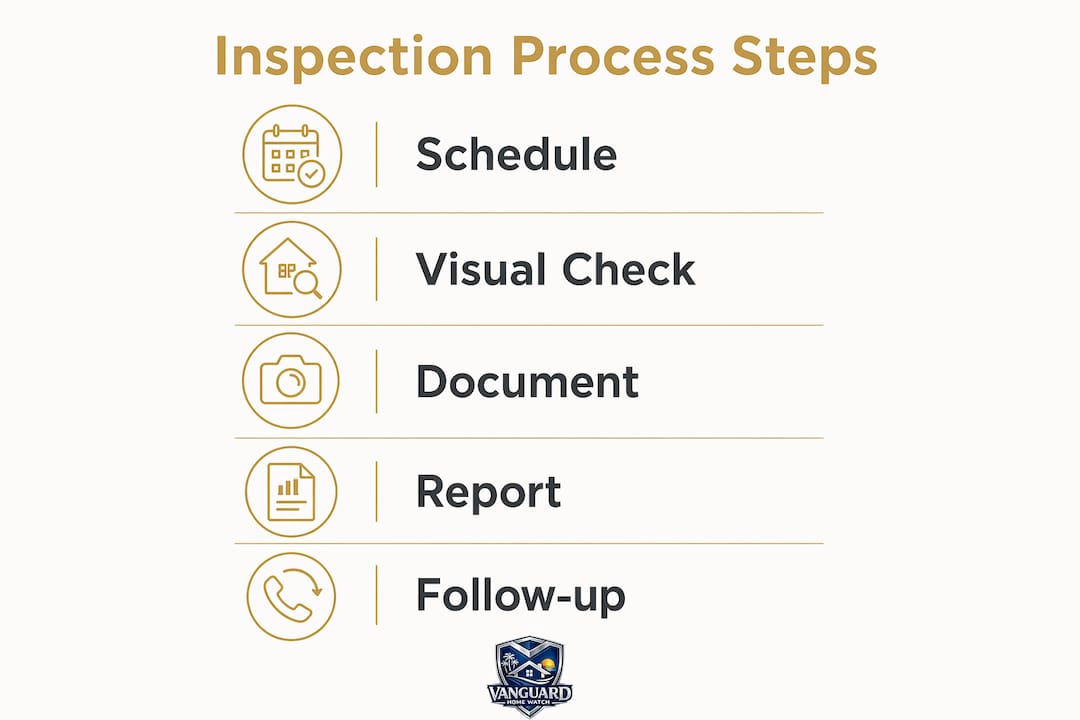
Once onboarding is complete, the process follows a consistent, repeating cycle:
- Scheduled inspection visit. Your provider arrives on a predetermined schedule, typically weekly, and works through a standardized checklist covering interior and exterior systems. This is not a casual walk-through. It is a methodical review of HVAC operation, plumbing, electrical panels, smoke and CO detectors, mold indicators, pest activity, roof condition, pool equipment, and security status.
- Digital documentation. Every finding is recorded using inspection software. Tools like iAuditor allow providers to attach timestamped photos directly to checklist items, creating an unambiguous record of conditions at the time of the visit.
- Report generation and delivery. After the inspection, a detailed digital report is automatically compiled and emailed to you. The report includes written notes, categorized findings, and photo evidence organized by property area.
- Issue flagging and response. When a problem is identified, such as a slow plumbing leak or a tripped breaker, the report flags it clearly. Your provider contacts you immediately for critical issues and coordinates with trusted vendors for repairs, with your authorization.
- Ongoing baseline comparison. Each new report is compared against the established baseline. This means your provider is not just noting what they see today. They are tracking changes over time, which is where early detection becomes genuinely valuable.
Pro Tip: The first two or three reports are especially important. Use them to calibrate your expectations and confirm the level of detail and communication style works for you before settling into a long-term routine.
How is professional home watch reporting different from informal check-ins?

A neighbor checking on your home is a kind gesture. It is not a professional inspection. The difference is not just thoroughness. It is documentation, consistency, and legal standing.
Professional home watch reporting uses comprehensive checklists and produces written, timestamped reports that create a verifiable audit trail. That audit trail is what separates a professional service from an informal visit when you need to file an insurance claim or prove your property was monitored during an absence.
Here is a direct comparison:
| Feature | Professional home watch | Informal neighbor check |
|---|---|---|
| Structured checklist | Yes, covers all major systems | No, based on visual impression |
| Timestamped photo documentation | Yes, every visit | Rarely, if ever |
| Consistent scheduled visits | Yes, regardless of weather or schedule | Variable, dependent on availability |
| Insurance-compliant reporting | Yes, satisfies vacancy clause requirements | No recognized standing |
| Vendor coordination for repairs | Yes, with homeowner authorization | No formal process |
| Professional liability coverage | Yes, insured and bonded | None |
The core distinction is that professional home watch is proactive and systematic, not reactive. A neighbor calls you if something looks obviously wrong. A professional provider identifies the slow humidity rise before the mold appears, or the HVAC that is running but not cooling before it fails completely.
Key advantages of professional reporting over informal visits:
- Findings are categorized as normal baseline conditions or flagged issues requiring action
- Reports are delivered automatically, so you never have to follow up to find out what was found
- Providers are background checked, insured, and bonded, giving you recourse if anything goes wrong
- Documentation supports your insurance coverage in ways that a text message from a neighbor never will
What are common elements in home watch inspection reports?
A well-structured home watch inspection report covers both interior and exterior systems in a consistent format. Typical inspection items include HVAC operation, plumbing leak checks, mold and moisture evidence, electrical panel status, smoke and CO detector function, roof and gutter condition, landscaping, pool equipment, and all entry point security.
Each item in the report follows the same structure: a written observation, a status designation (normal or flagged), and one or more timestamped photos. This format makes reports easy to scan quickly and easy to reference later if a dispute arises with a contractor or insurer.
Pro Tip: Ask your provider to include a brief written summary at the top of each report. A two-sentence overview of overall property condition lets you assess the visit at a glance before reviewing the detailed findings.
Findings fall into two categories. Normal baseline findings confirm that systems are operating as expected and conditions match the established profile. Flagged findings identify deviations that require your attention, ranging from minor items like a burned-out exterior light to urgent issues like standing water near a water heater.
The report also serves as a coordination tool. When vendors need to be dispatched for repairs, the report provides the documentation contractors need to understand the issue before they arrive. This saves time, reduces miscommunication, and gives you a written record of when the problem was first identified. For property investors managing multiple units, this paper trail is particularly valuable when tracking maintenance history and vendor performance across properties.
A thorough report also documents exterior conditions after weather events. In Florida, this means post-storm assessments of roof integrity, window seals, and drainage. Providers familiar with local risks, like those serving Naples and the surrounding Collier County area, adapt their inspection checklists to reflect seasonal and climate-specific vulnerabilities.
How does home watch reporting support insurance compliance?
Insurance companies often require proof that vacant homes are actively monitored. Without professional documentation, claims for water damage, theft, or storm loss may be denied outright. This is one of the most consequential and least understood aspects of owning a seasonal or vacant property.
“Written reports with photo documentation create timestamped inspection records that satisfy insurer vacancy clause requirements, enabling claims for damage that occur during homeowner absence. Clients have proactively shared these reports with insurers to confirm compliance.” — Suncoast Home Watch FAQ
The practical steps for using home watch reporting to protect your insurance coverage are straightforward:
- Confirm your policy’s vacancy clause. Contact your insurer before your next absence and ask specifically what documentation they require for a property unoccupied for more than 30 days. Many policies require proof of regular monitoring.
- Establish reporting frequency that matches insurer expectations. Weekly visits with documented reports are the standard that most carriers recognize. Monthly visits may not satisfy vacancy clause requirements.
- Store your reports systematically. Keep a digital archive of every report. If a claim arises, you need to produce records quickly. Cloud storage organized by date and property address works well for this.
- Share reports proactively with your insurer. Some homeowners send quarterly report summaries to their insurance agent as a routine practice. This builds a documented compliance record before any claim is ever needed.
Home watch reporting also functions as risk mitigation in the most direct sense. A provider who identifies a failing water heater during a weekly visit prevents a claim entirely. The cost of a replacement water heater is a fraction of the cost of water damage remediation, mold treatment, and the associated insurance complications.
Key takeaways
A professional home watch reporting process protects vacant properties through documented, timestamped inspections that satisfy insurance requirements and enable early issue detection before minor problems become expensive repairs.
| Point | Details |
|---|---|
| Reporting starts with onboarding | Initial property assessment establishes baseline conditions that every future report is measured against. |
| Reports are photo-supported and timestamped | Digital documentation creates a verifiable audit trail that informal check-ins cannot replicate. |
| Insurance compliance depends on documentation | Carriers may deny vacancy claims without professional reports proving regular, scheduled monitoring. |
| Flagged findings trigger vendor coordination | Issues identified in reports are escalated immediately, with repairs coordinated on your behalf. |
| First reports calibrate the process | Early inspections let you confirm reporting detail, communication style, and coverage meet your expectations. |
What 15 years of watching properties taught me about reporting
Most homeowners come to us after something went wrong. A water leak ran for two weeks before anyone noticed. A neighbor mentioned the AC unit sounded strange but never followed up. An insurance claim got complicated because there was no documentation of the property’s condition before the damage occurred. Every one of those situations was preventable with a consistent reporting process in place.
What I have found is that homeowners often underestimate the value of the baseline. The first few reports are not just about finding problems. They are about establishing what normal looks like for your specific property. Once that baseline exists, every subsequent report becomes a comparison. A slight humidity increase, a door that was previously secure now showing signs of movement, a pool chemistry reading that has drifted. These are the findings that prevent the expensive surprises.
I also want to address a common misconception: home watch reporting is not about catching catastrophes. It is about catching the conditions that lead to catastrophes. The mold does not appear overnight. The roof leak starts as a compromised seal. The pest infestation begins with a single entry point. Consistent, documented inspections catch these early signals before they escalate.
For property investors specifically, the reporting record has value beyond the immediate inspection. It documents the condition of the property over time, supports maintenance planning, and provides evidence of due diligence if a tenant or buyer ever raises a concern about property condition. Think of every report as a permanent entry in your property’s history.
— Joseph
Protect your Naples property with trusted home watch reporting
Vanguard Home Watch LLC provides weekly visual inspections and detailed digital reports with photos for vacant and seasonal homes throughout Naples, North Naples, and Ave Maria, Florida. Founded by retired law enforcement lieutenant Joseph Vangelakos and real estate professional Elizabeth Vangelakos, we personally conduct every inspection and deliver every report. We are fully insured, bonded, background checked, and accredited members of the National Home Watch Association (NHWA).
If you are ready to put a professional reporting process in place for your property, learn exactly what a home watch inspector does during each visit, or contact us directly to schedule your initial property assessment. Your property deserves consistent, documented oversight you can count on.
FAQ
What is the home watch reporting process?
The home watch reporting process is a scheduled, documented visual inspection of a vacant or seasonal property, resulting in a timestamped, photo-supported digital report delivered to the homeowner after each visit. It covers interior and exterior systems including HVAC, plumbing, mold, security, and structural condition.
How often should home watch inspections be conducted?
Weekly inspections are the professional standard recognized by most insurance carriers for vacant property monitoring. Monthly visits may not satisfy vacancy clause requirements, leaving homeowners at risk of denied claims.
Can home watch reports help with insurance claims?
Yes. Timestamped photo reports satisfy insurer vacancy clause requirements and provide verifiable evidence of property condition before and after a loss event. Without this documentation, claims for water damage, theft, or storm loss may be denied.
What is the difference between home watch and property management?
Home watch is proactive and inspection-focused, built specifically to monitor vacant properties and satisfy insurance requirements. Property management handles tenant relations, rent collection, and maintenance coordination for occupied rental properties. The two services serve different purposes and are not interchangeable.
What happens when a home watch provider finds a problem?
When an issue is identified, the provider flags it in the report and contacts the homeowner immediately for urgent matters. For non-critical findings, vendors are coordinated with homeowner authorization to address repairs promptly, minimizing damage and cost.

