A home watch service exclusion is a defined boundary in your service agreement that specifies which property care tasks a home watch provider will not perform during scheduled inspections of your vacant home. Understanding what is a home watch service exclusion explained in your contract is not optional reading. It is the difference between knowing your property is protected and discovering a costly gap after something goes wrong. Professional home watch providers, including National Home Watch Association (NHWA) accredited companies, operate within a strict inspection-and-report model. That model exists by design, and knowing where it ends is as important as knowing where it begins.
What does home watch exclude from its scope?
Home watch services are defined as scheduled inspections of unoccupied properties focused on issue detection, explicitly excluding active property management tasks such as tenant management or rent collection. That distinction matters because many homeowners sign contracts expecting a broader safety net than the service actually provides.
The most common home watch service exclusions fall into these categories:
- Repairs and maintenance. A home watch inspector identifies a failing HVAC unit or a slow water leak. They document it and notify you. They do not fix it. Repairs are coordinated with licensed contractors, not performed by the home watch provider.
- Tenant management and rent collection. Home watch is not property management. If your home is rented between your visits, a separate property manager handles leases, tenant disputes, and rent.
- Landscaping and exterior upkeep. Mowing, trimming, and irrigation maintenance fall outside the inspection scope. A home watch provider may note that your lawn looks overgrown, but they will not schedule a landscaping crew without a separate concierge arrangement.
- Major cleaning or housekeeping. Pre-arrival cleaning or post-storm cleanup is not included in a standard home watch agreement.
- Package handling and mail forwarding. Some providers offer this as a small add-on task, but it is not a core inspection function.
Why do providers limit their scope this way? The answer is liability and expertise. A home watch company is trained to detect and document, not to repair or manage. Mixing those roles creates insurance complications and dilutes the quality of both services. Home watch pricing reflects this focused scope, typically running $2,500 to $4,000 annually in Florida for weekly visits, reports, and emergency response coordination. That cost is substantially less than the repair bills avoided through early detection.
Pro Tip: Ask any provider to give you their written exclusion list before signing. A reputable company will hand it over without hesitation. If they cannot produce one, that is a red flag about their professionalism and contract clarity.

How does home watch differ from property management and concierge services?
The most common misconception is confusing home watch with property management. Experts consistently stress that home watch is inspection-focused, while property management centers on tenant relations and income generation. Concierge services occupy a third category entirely.
Here is how the three services compare:
| Service type | Primary focus | Fee structure | Repair/maintenance role |
|---|---|---|---|
| Home watch | Visual inspection and issue detection | Flat monthly or annual fee | None. Coordinates with contractors. |
| Property management | Tenant relations, rent collection, leasing | Percentage of monthly rent | Arranges repairs up to a set dollar limit |
| Concierge / estate management | Vendor coordination, home preparation, lifestyle tasks | Higher flat or hourly fees | Broader vendor management included |
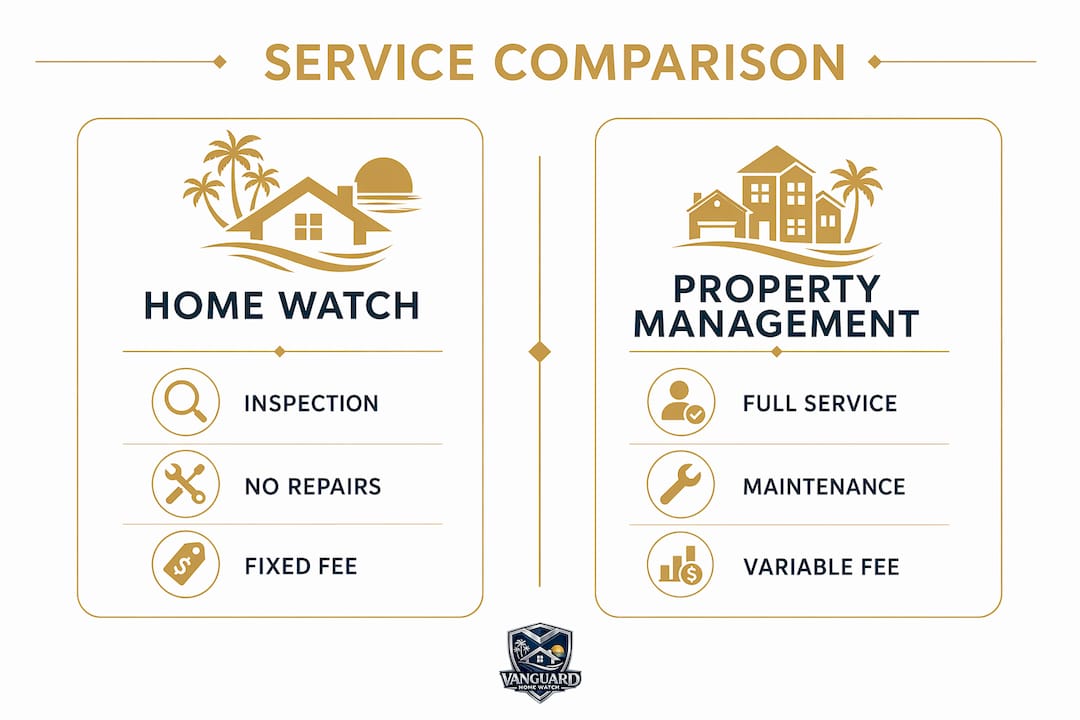
An estimated 6,000 home watch companies operate in the U.S., most of them small, owner-operated businesses with a focused specialty in inspections. That specialization is a strength, not a limitation. A home watch provider who also tries to manage tenants or perform repairs is spreading their attention across disciplines that require different licenses, insurance, and training. For absentee homeowners in Naples or Southwest Florida, understanding this separation helps you build the right team rather than expecting one provider to do everything.
Concierge or luxury estate management services offer broader task coverage, including vendor scheduling, home preparation before your arrival, and lifestyle coordination. These services cost more and serve a different need. Home watch sits at the foundation of that structure, providing the documented oversight that everything else depends on.
Why do home watch exclusions matter for your insurance coverage?
Homeowner’s insurance policies commonly include vacancy clauses that may void claims if homes remain unoccupied 30 to 60 days without documented inspections. This is where home watch service exclusions carry direct financial consequences for you.
When a home watch provider inspects your property and delivers a written report with timestamped photos, that report becomes your evidence of ongoing oversight. It satisfies the insurance company’s requirement that the property was being monitored. Without it, a mold claim or water damage claim filed after a 45-day absence can be denied outright.
Here is what the exclusion boundary means in insurance terms:
- A home watch provider documents a roof leak after a storm. That report protects your claim.
- A home watch provider does not perform the roof repair. That is the contractor’s job.
- If a neighbor informally checks your home and misses the leak, liability complications arise. The neighbor is not insured or bonded. If they are injured on your property during that check, you may face a claim.
Professional home watch companies are insured and bonded, which removes that liability exposure entirely. Written reports with photos after each visit are critical evidence proving ongoing oversight of a vacant property. That documentation is what your insurance carrier needs, and it is precisely what an informal neighbor check cannot provide.
Pro Tip: Request a copy of your home watch provider’s certificate of insurance and confirm it covers general liability and errors and omissions. Also review your own homeowner’s policy for the specific vacancy clause language so you know exactly how many days trigger a coverage gap. A mold remediation insurance checklist can help you understand what documentation insurers typically require when filing claims related to moisture damage in vacant homes.
Common misconceptions about home watch service scope
Misunderstanding what home watch includes is the leading cause of homeowner dissatisfaction with the service. These are the myths that create the most problems:
- “My home watch provider will fix what they find.” They will not. Their role is managing condition, not executing repairs. They identify the problem, notify you, and help coordinate a contractor if needed.
- “A neighbor checking in is basically the same thing.” It is not. Professional home watch providers follow detailed checklists and are trained to detect subtle signs of moisture or HVAC issues that an untrained neighbor would likely miss. Certification from organizations like the NHWA and systematic inspection protocols create a documented record that a casual visit never produces.
- “Home watch covers everything a property manager does.” These are separate services with separate scopes, fee structures, and licensing requirements. Expecting one to replace the other leads to gaps in both tenant oversight and property condition monitoring.
- “If I have a property manager, I don’t need home watch.” Property managers focus on tenant relations. When a property sits vacant between tenants or during off-season months, a home watch provider fills the oversight gap that a property manager is not contracted to cover.
The practical cost of these misconceptions is real. Homeowners who assume their home watch provider will handle repairs often delay calling a contractor, turning a $300 plumbing fix into a $15,000 water damage restoration.
How to select a home watch service with clear exclusions
Choosing the right provider starts with asking the right questions. Here is a structured approach:
- Request the written service agreement and exclusion list upfront. Any provider worth hiring will have both documents ready. Review them before the first visit, not after.
- Verify NHWA accreditation or equivalent professional credentials. The National Home Watch Association sets industry standards for training, ethics, and documentation. Accredited members have agreed to those standards in writing.
- Confirm the provider is bonded and insured. Ask for a certificate of insurance naming general liability and, where applicable, errors and omissions coverage.
- Ask about report delivery. A professional home watch service delivers a written report with photos after every visit. Understand the format, frequency, and how quickly you receive it after each inspection.
- Clarify emergency response protocols. When a provider finds water pouring from a burst pipe at 2 a.m., what happens next? Who do they call? Do they have a vetted vendor network? This is a critical detail that exclusion-focused contracts sometimes leave vague.
- Ask about local knowledge and vendor relationships. A provider with established relationships with Naples-area plumbers, HVAC technicians, and restoration companies can get someone to your property faster than a provider who has to search for a contractor in a crisis.
The benefits of home watch service for seasonal owners are directly tied to how clearly the service scope is defined from day one. A provider who communicates exclusions clearly is a provider who understands their own role, and that clarity protects you.
Key takeaways
Home watch service exclusions define the inspection-only boundary of a provider’s role, and understanding that boundary is what protects your property, your insurance coverage, and your financial exposure as an absentee homeowner.
| Point | Details |
|---|---|
| Exclusions define the scope | Home watch covers inspection and detection only. Repairs, tenant management, and landscaping are excluded. |
| Insurance documentation matters | Timestamped inspection reports satisfy vacancy clause requirements and support damage claims. |
| Neighbor checks are not equivalent | Untrained informal checks lack documentation, checklists, and liability coverage. |
| Service types are distinct | Home watch, property management, and concierge services serve different needs and should not be conflated. |
| Verify credentials before hiring | NHWA accreditation, bonding, and insurance are non-negotiable qualifications for any professional provider. |
What I’ve learned from homeowners who got the exclusions wrong
After years of working with absentee homeowners in Naples and Southwest Florida, I can tell you that the most preventable problems we see come from one source: a homeowner who assumed their home watch provider would handle something the contract never promised.
The pattern is consistent. A homeowner returns after six months away to find mold behind a bathroom wall. They assumed their provider would have addressed the moisture source. The provider did exactly what they were hired to do. They detected elevated humidity, documented it in three consecutive reports, and sent notifications each time. The homeowner did not act on those notifications because they assumed someone else would. That is not a failure of home watch. That is a failure of understanding what home watch excludes.
What I tell every new client is this: read the exclusion list the same way you read your insurance policy. The value is not in what it covers. The value is in knowing exactly where your responsibility begins. A good home watch provider is your eyes and your early warning system. They are not your contractor, your property manager, or your handyman. When you accept that boundary, you build a response plan around it, and that plan is what actually protects your home.
The industry is maturing. NHWA standards are raising the floor for documentation and professionalism across the board. But homeowner education still lags behind. The homeowners who get the most out of this service are the ones who ask hard questions before signing, not after something goes wrong.
— Joseph
Protect your Naples home with transparent, documented oversight
Vanguard Home Watch LLC serves Naples, North Naples, and Ave Maria with weekly visual inspections that detect water leaks, HVAC failures, mold, pest activity, storm damage, and security concerns before they become costly repairs. Every visit produces a detailed digital report with photos, delivered directly to you. We are fully insured, bonded, background checked, and accredited members of the National Home Watch Association. As a retired law enforcement lieutenant and real estate professional, Joseph and Elizabeth Vangelakos personally oversee every client relationship. Learn exactly what a home watch inspector does for your property, or visit Vanguard Home Watch LLC to request a free consultation today.
FAQ
What is a home watch service exclusion?
A home watch service exclusion is a contractual boundary specifying tasks the provider will not perform, such as repairs, tenant management, landscaping, or major cleaning. The provider’s role is limited to visual inspection, documentation, and issue notification.
Does home watch cover repairs when something breaks?
No. A home watch provider detects and documents problems like a burst pipe or HVAC failure, then notifies the homeowner and helps coordinate a licensed contractor. Performing repairs directly falls outside the defined scope of home watch services.
Can a neighbor substitute for a professional home watch service?
A neighbor cannot replicate professional home watch because they lack structured checklists, insurance, bonding, and the training to detect subtle signs of moisture or HVAC failure. Their informal checks also produce no documentation to satisfy insurance vacancy clause requirements.
How do home watch exclusions affect my homeowner’s insurance?
Insurance vacancy clauses can void claims if a home sits unoccupied 30 to 60 days without documented inspections. Professional home watch reports with timestamped photos provide the proof insurers require, while the exclusion of repairs keeps the provider’s liability clearly defined.
What credentials should I verify before hiring a home watch provider?
Verify NHWA accreditation, a current certificate of general liability insurance, bonding, and a written service agreement that clearly lists both included services and exclusions. Providers who cannot produce these documents on request should not be trusted with an unoccupied property.
