Referring home watch service clients is the practice of connecting your buyers, sellers, or managed property owners with a licensed, insured, and accredited provider who monitors vacant or seasonal homes on their behalf. For Realtors and property managers in Naples, North Naples, and across Southwest Florida, this referral is not a casual suggestion. It is a professional recommendation that directly affects your client’s property, your liability exposure, and your long-term reputation. The best home watch referrals are structured, compliant with Florida law, and backed by providers who deliver documented inspections with photo reports after every visit. Vanguard Home Watch LLC, accredited by the National Home Watch Association (NHWA), is one example of the standard you should require before referring anyone.
What legal considerations should Realtors know before referring home watch clients?
Florida law draws a clear line between home watch services and property management, and crossing it creates real legal risk for Realtors. Watch-home services that consist only of physical inspection, emergency access and key-holding, and basic maintenance coordination are exempt from broker-license requirements under Florida Statutes §475.01 and §475.42. The moment a provider begins coordinating rentals, collecting rent, or negotiating leases, a broker license is required. This distinction matters because your referral implicitly endorses the scope of services your client receives.
Positioning referrals carefully as asset-protection monitoring rather than property management keeps both you and your client on the right side of Florida law. Use language like “property inspection and monitoring service” rather than “property management” when describing the referral to your client. This framing is accurate, professional, and legally sound.
Before you refer any provider, verify the following:
- Proof of general liability insurance and bonding, with your client named or acknowledged as a protected party
- Background checks on all personnel who will access the property
- NHWA accreditation or equivalent professional membership confirming adherence to industry standards
- Written service agreements that define scope, frequency, and reporting format
- No rental or leasing activity in the provider’s service description
Pro Tip: Ask the provider directly: “Do you coordinate rentals or tenant placement?” If the answer is yes or unclear, do not refer them to your clients. A home watch provider’s scope must stay within inspection and monitoring to remain exempt from broker licensing under Florida law.
Maintaining two separate providers without coordination, one for watch-home services and one for rental management, can create duplicated efforts and complicate emergency access. A coordinated partnership between a broker-licensed property manager and a dedicated home watch provider is the cleaner, safer structure for clients who need both services.
What qualifications should you require from a home watch provider?
Not every home watch company operates at the same standard, and the difference between a credible provider and an informal one becomes obvious the moment a problem occurs at a client’s property. NHWA accreditation signals that a provider carries insurance, conducts background checks, and follows documented inspection protocols. This is the baseline, not a bonus feature.
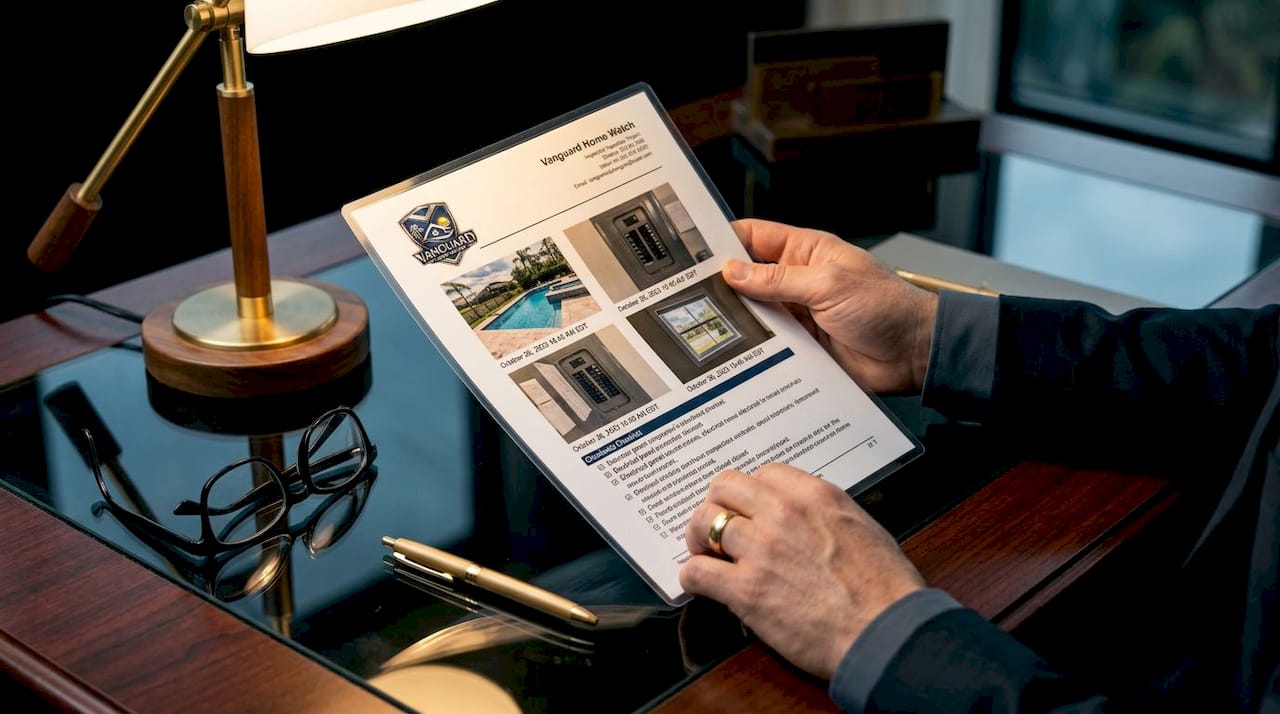
Structured reporting including time-stamped photos and direct owner communication is what separates a professional home watch company from a neighbor checking the mail. Providers in Palm Beach County, for example, deliver documented inspection reports covering interior and exterior conditions, HVAC, and plumbing, delivered to owners regardless of their location. Your clients in Toronto or Chicago deserve the same level of transparency.
Use this comparison when evaluating providers:
| Qualification | What to look for |
|---|---|
| NHWA accreditation | Confirms insurance, background checks, and professional standards |
| Inspection frequency | Weekly visits with documented, time-stamped photo reports |
| Emergency response | Clear protocol for water leaks, HVAC failures, storm damage |
| Local Florida knowledge | Familiarity with humidity, mold risk, and hurricane preparedness |
| Client references | Verifiable reviews from seasonal or absentee homeowners |
| Technology tools | Digital reporting platform accessible to owners remotely |
Pro Tip: Request a sample inspection report before committing to a referral relationship. A provider who cannot produce a clean, photo-documented report on demand is not ready to serve your clients.
The benefits of home watch services for seasonal owners extend well beyond peace of mind. Weekly inspections catch HVAC failures before mold sets in, identify pest activity before an infestation takes hold, and document storm damage before an insurance claim window closes. These are the outcomes your clients care about, and they are only possible with a provider who shows up consistently and reports accurately.
How can you build an effective referral process for home watch services?
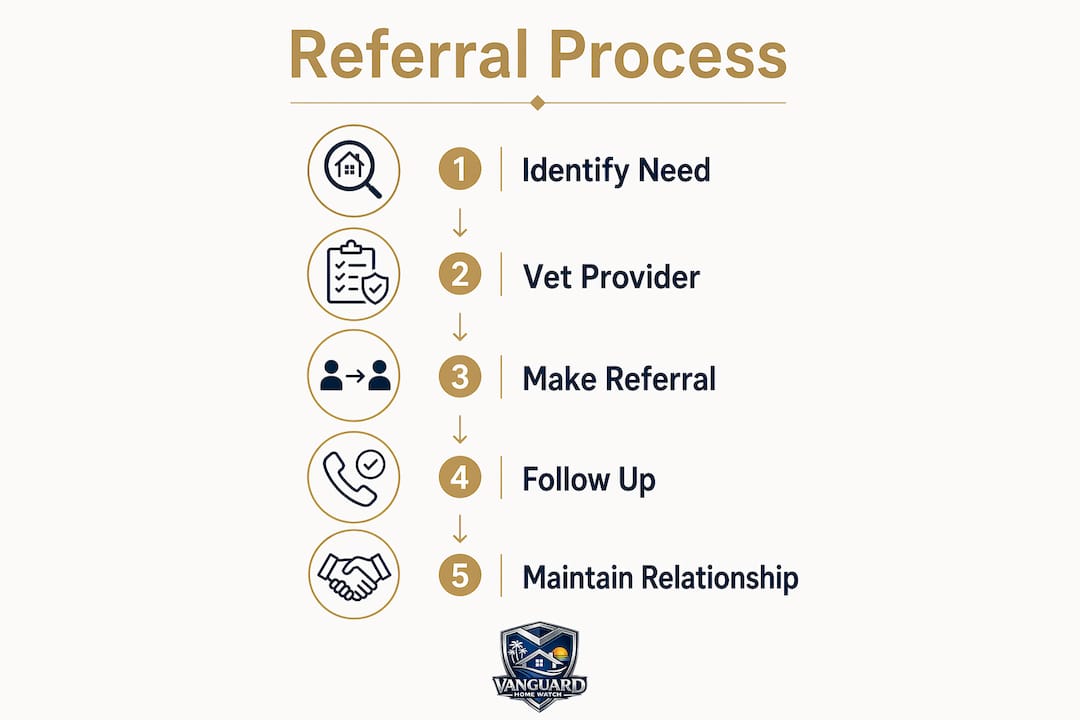
A structured referral process converts more clients and protects your professional reputation better than any informal recommendation. Referral programs that define best-fit clients, create easy handoffs, and track outcomes consistently outperform ad hoc approaches. The ProTradeHQ model for contractor referral programs applies directly here: define the ideal client profile, create a frictionless introduction, and follow up fast.
Here is a step-by-step process you can implement immediately:
- Define your ideal referral candidate. Seasonal homeowners leaving for more than 30 days, buyers closing on a second home, and sellers with vacant listings are your highest-value referral opportunities.
- Prepare a one-page service summary. Your home watch partner should supply this. It covers service scope, inspection frequency, reporting format, and pricing range. You hand it to the client at the right moment.
- Make the introduction promptly. Referral asks made within 48 hours of a positive client interaction convert at significantly higher rates. The closing table, the final walkthrough, and the seasonal departure conversation are your three highest-value moments.
- Set a same-business-day response expectation. Your home watch partner must contact the referred client within one business day. Slow follow-up erodes the trust you built with the referral.
- Confirm the connection was made. A quick text or email to your client after the introduction confirms the handoff and shows you are invested in their outcome.
- Track every referral. Use a simple spreadsheet or a CRM field to log the client name, referral date, provider contacted, and outcome. This data tells you which partners perform and which do not.
Beyond the mechanics, timing matters more than most Realtors realize. Structured referral systems that formalize timing, criteria, and tracking consistently outperform memory-based approaches. Relying on remembering to mention home watch during a busy closing is not a referral strategy. It is a missed opportunity.
The role of home watch in real estate transactions is growing as more buyers purchase second homes in Florida without local support networks. Your referral fills a genuine gap and positions you as a full-service advisor, not just a transaction facilitator.
What common mistakes should you avoid when referring home watch clients?
Most referral failures trace back to one of five predictable problems. Recognizing them in advance keeps your client relationships intact and your professional standing protected.
- Delayed or absent follow-up. If your home watch partner does not contact the client within 24 to 48 hours, the referral loses momentum and the client loses confidence in both of you. Set this expectation in writing before the first referral.
- Scope confusion. Clients who believe they are receiving property management, rental coordination, or concierge services when they are receiving inspection-only monitoring will be disappointed. Clarify scope before the introduction, not after.
- Referring unvetted providers. A provider without NHWA accreditation, verifiable insurance, or background-checked staff is a liability. Accreditation, insurance, and background checks are non-negotiable indicators of a trustworthy home watch service, not optional extras.
- Informal, memory-based referrals. Mentioning a provider’s name without a written introduction, a service summary, or a follow-up plan produces inconsistent results. Structured processes convert; casual mentions do not.
- Ignoring legal framing. Describing a home watch referral as “property management” to a client is inaccurate and potentially exposes you to liability if the provider’s scope does not match that description.
Pro Tip: Create a short referral script you use consistently. Something like: “I work with a trusted home watch company that conducts weekly inspections and sends you a photo report after every visit. They are NHWA accredited, fully insured, and background checked. I will connect you directly.” This framing is accurate, professional, and sets the right expectations.
How do you maintain strong referral relationships over time?
A single successful referral is a transaction. A referral relationship that generates consistent business over years is an asset. The difference lies in how you manage the partnership after the first introduction.
- Schedule monthly check-ins with your home watch partner. A 15-minute call or a brief email exchange keeps both parties aligned on client needs, seasonal patterns, and any service issues that need addressing.
- Share seasonal checklists with your partner. Florida’s hurricane season, the snowbird departure window in April, and the return window in October are predictable inflection points. Coordinating around these moments produces better client outcomes and more referral opportunities.
- Request post-referral feedback from clients. Ask your client directly: “How has the home watch service been working for you?” This feedback tells you whether the referral is performing and gives you material for refining your process.
- Align referrals with specific client needs. A client with a waterfront property in Naples has different risk exposure than one with an inland condo in Ave Maria. Match the referral to the property profile, not just the geography.
- Use referral outcome data to evaluate partners. If a partner consistently fails to follow up promptly, generates client complaints, or cannot produce clean inspection reports, replace them. Your reputation depends on the quality of every provider you recommend.
Referral partners perform best when they receive clear, fast handoffs and regular updates. This is a two-way relationship. The more organized and communicative you are as the referring professional, the better service your clients receive.
Key takeaways
Referring home watch service clients effectively requires legal compliance, provider vetting, and a structured process that converts introductions into lasting client satisfaction.
| Point | Details |
|---|---|
| Legal compliance first | Frame referrals as asset-protection monitoring, not property management, to stay within Florida Statute §475 exemptions. |
| Vet providers rigorously | Require NHWA accreditation, verifiable insurance, background checks, and documented photo reporting before referring. |
| Time referrals strategically | Make introductions within 48 hours of positive client contact for the highest conversion rates. |
| Build a structured process | Use a defined referral script, written handoff, and CRM tracking to replace informal, memory-based recommendations. |
| Maintain the relationship | Monthly partner check-ins and post-referral client feedback keep the referral network performing at a high level. |
What I have learned from building referral relationships in Southwest Florida
Having spent years in law enforcement and real estate before founding Vanguard Home Watch LLC with Elizabeth, I have watched a lot of well-intentioned referrals go sideways. The pattern is almost always the same. A Realtor mentions a home watch provider at closing, the client nods, and nothing happens. Three months later, the client calls the Realtor because something went wrong at the property and they never actually connected with the provider.
The referral did not fail because the Realtor did not care. It failed because there was no process. No written introduction. No follow-up confirmation. No expectation set with the home watch partner about response time. The fix is not complicated, but it requires treating the referral like a professional handoff rather than a casual mention.
What I find most Realtors underestimate is how much a strong home watch referral does for their own reputation. When a client calls you six months after closing to say their home watch provider caught a slow leak before it became a $40,000 remediation claim, that is a relationship that generates referrals back to you. The trust flows in both directions. Invest in the process, vet your partners carefully, and your clients will remember you as the professional who protected their most valuable asset.
— Joseph
Partner with Vanguard Home Watch for reliable client referrals
Vanguard Home Watch LLC serves Realtors and property managers across Naples, North Naples, and Ave Maria with weekly visual inspections, time-stamped photo reports, and a direct line to owners after every visit. We are fully insured, bonded, background checked, and accredited by the National Home Watch Association. Founded by retired law enforcement lieutenant Joseph Vangelakos and real estate professional Elizabeth Vangelakos, we bring a level of accountability and documentation that protects your clients and your professional reputation. If you are ready to refer home watch service clients with confidence, connect with our team to discuss a referral partnership built around your clients’ needs.
FAQ
What does it mean to refer home watch service clients?
Referring home watch service clients means connecting your buyers, sellers, or managed property owners with an accredited provider who conducts scheduled visual inspections of vacant or seasonal homes. The referral is a professional recommendation, not a casual suggestion, and it carries reputational weight.
Do Realtors need a broker license to refer home watch services in Florida?
No. Referring clients to a home watch provider that limits its scope to inspections and key-holding does not require a broker license under Florida Statutes §475.01 and §475.42. The exemption disappears the moment the provider engages in rental or leasing activity.
What is NHWA accreditation and why does it matter for referrals?
NHWA accreditation, issued by the National Home Watch Association, confirms that a provider carries insurance, conducts background checks, and follows documented inspection protocols. Accredited providers give referring Realtors and property managers a verifiable standard to stand behind.
When is the best time to refer a client to a home watch service?
The highest-conversion moments are the closing table, the final walkthrough, and the seasonal departure conversation. Making the introduction within 48 hours of a positive client interaction produces the best results.
How do you track home watch referrals effectively?
Log each referral in a CRM or spreadsheet with the client name, referral date, provider contacted, and outcome. This data identifies which partners follow up promptly and which generate client satisfaction, allowing you to refine your referral network over time.

