Leaving a luxury estate vacant for months is not a passive act. It’s a decision that carries real financial and structural risk, and the difference between a problem caught early and a catastrophic loss often comes down to who is checking on your property, how often, and what proof they leave behind. The role of home watch in luxury estate management is a subject many seasonal owners and absentee property managers underestimate until something goes wrong. This guide clarifies exactly what home watch is, how it differs from full estate management, and what professional standards you should demand before entrusting anyone with the keys to a high-value property.
Table of Contents
- Key Takeaways
- The role of home watch in luxury estate care
- Luxury estate management: beyond routine inspections
- Technology and documentation: protecting value and insurance coverage
- Choosing the right provider for your estate
- Common misconceptions that cost property owners money
- My perspective: what I’ve learned after years of protecting vacant estates
- Protect your estate with Vanguard Home Watch LLC
- FAQ
Key Takeaways
| Point | Details |
|---|---|
| Home watch is routine inspection | Scheduled visual checks catch HVAC failures, leaks, and mold before minor issues become expensive repairs. |
| Estate management goes further | Full estate oversight coordinates vendors, contractors, and complex systems beyond what inspections alone cover. |
| Documentation protects your claim | Timestamped photos and GPS-verified logs satisfy insurer requirements and reduce the risk of claim disputes. |
| Provider vetting is non-negotiable | Insurance, background checks, and NHWA accreditation separate trustworthy providers from unprotected risk. |
| Technology lowers insurance costs | Smart monitoring and verified inspection records can reduce vacancy surcharges and improve policy terms. |
The role of home watch in luxury estate care
Home watch is a formal discipline, not a favor from a neighbor. The National Home Watch Association (NHWA) defines home watch as a visual inspection of a home looking for obvious issues, combined with consistent documentation to mitigate risk. The goal is early detection, not elimination of every possible problem. That distinction matters. No service can guarantee nothing will go wrong. What professional home watch does guarantee is that when something does go wrong, it gets found fast.
A typical inspection covers far more than a quick walkthrough. A credentialed provider checks:
- Interior and exterior conditions, including signs of water intrusion, pest activity, and storm damage
- HVAC operation and filter status, since system failures in Florida humidity accelerate mold growth within days
- Plumbing fixtures, water heaters, and supply lines for active leaks or signs of moisture
- Appliances, circuit breakers, and smoke and carbon monoxide detectors
- Windows, doors, and locks for security concerns or weather-related damage
- Pool equipment, irrigation systems, and exterior lighting
What separates a professional home watch visit from an informal check-in is documentation. Every visit should produce a written report with timestamped photos and GPS verification. This evidence chain serves you directly. It gives you visibility into your property’s condition from anywhere in the country, and it gives your insurer proof that the property was actively monitored.
Pro Tip: Ask any provider you consider to show you an actual sample report from a recent inspection. If they cannot produce one with photos, timestamps, and written observations, they are not operating at a professional standard.
Accreditation also matters significantly. NHWA-accredited providers must carry insurance specific to home watch services, pass background checks, and follow documented protocols for key handling and client data. Many companies advertising home watch services hold none of these credentials, which leaves you exposed in ways you may not discover until a claim is denied.
Luxury estate management: beyond routine inspections
Home watch and estate management are complementary services, but they are not interchangeable. Understanding the difference helps you decide what level of oversight your property actually requires.
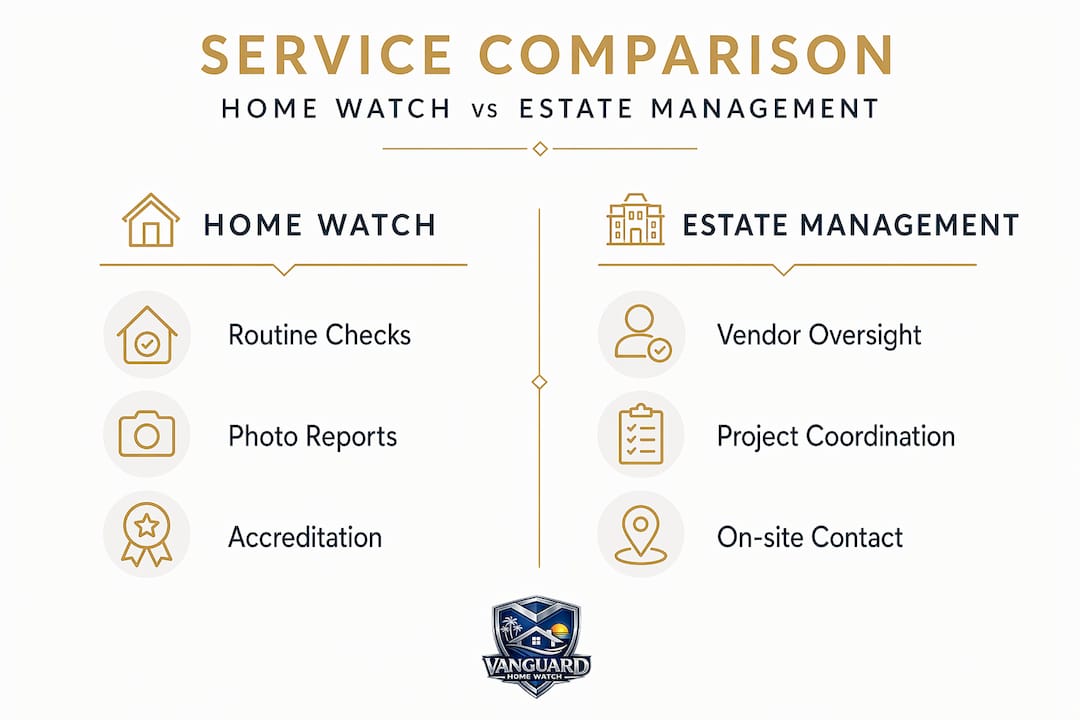
Home watch is primarily inspection-based. An accredited provider visits on a scheduled cadence, documents what they observe, flags issues, and reports back to you. That model works extremely well for a seasonal residence that is maintained in good condition and does not have elaborate systems requiring active management between visits.
Estate management goes further. Estate managers serve as the on-site point of contact for contractors handling pools, generators, gated access systems, and other complex infrastructure. They do not just report problems. They coordinate the response, vet vendors, manage timelines, and verify that work is completed correctly before paying invoices.
| Service | Home watch | Estate management |
|---|---|---|
| Scheduled inspections | Yes | Yes |
| Written reports with photos | Yes | Yes |
| Contractor coordination | No | Yes |
| Vendor vetting and oversight | No | Yes |
| Complex system management | No | Yes |
| Maintenance scheduling | Limited | Full |
| On-site emergency response | Detection only | Active resolution |
For a 3,000 square foot seasonal home in a gated Naples community, home watch may be exactly what you need. For a 10,000 square foot estate with a pool, a generator, smart home automation, a private gate, and a groundskeeping schedule, full estate management services provide a centralized accountability structure that no single inspection visit can replicate. The right answer depends on your property’s complexity, not just its value.
Technology and documentation: protecting value and insurance coverage
This is where many luxury property owners leave money on the table without realizing it. Modern home watch practice uses a combination of smart-home monitoring, timestamped photography, GPS-verified visit logs, and digital reporting to build what the industry calls an evidence chain. Each visit is a documented data point, and collectively those data points tell a clear story about your property’s condition over time.
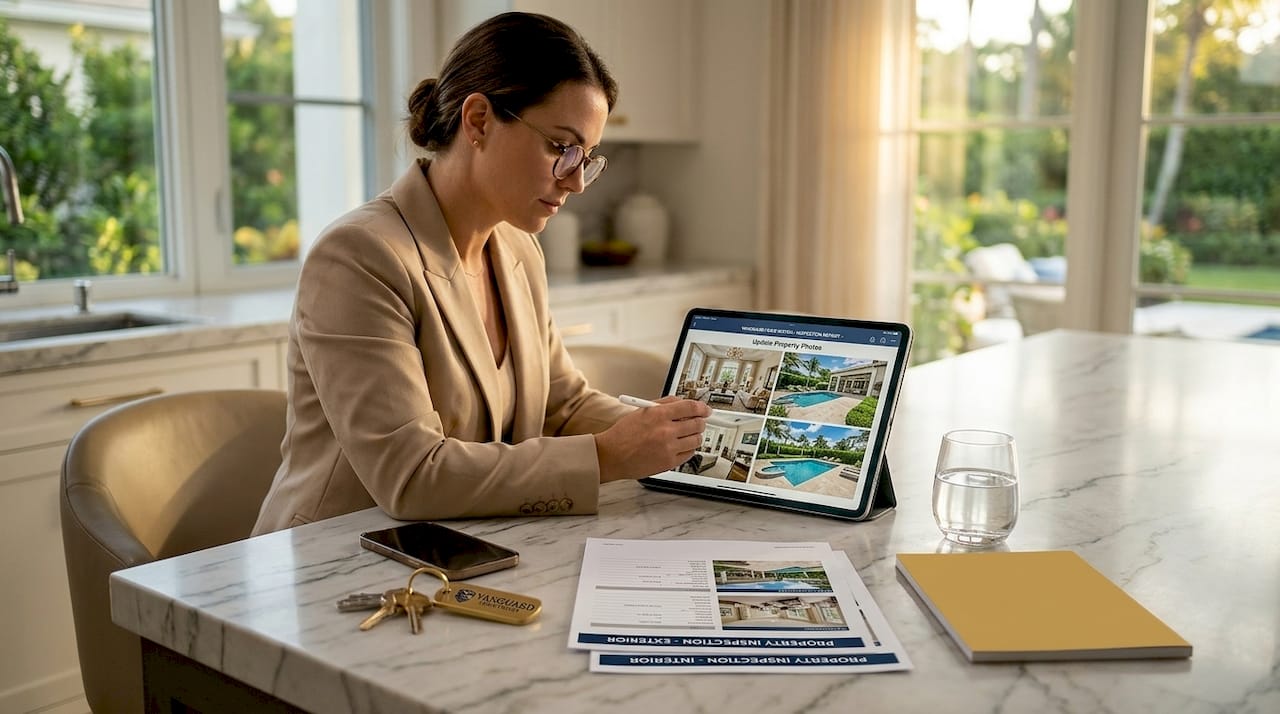
That story matters enormously to your insurance carrier. Many unoccupied home policies require physical inspections every 14 days with timestamped photo evidence to keep coverage active. If a claim arises and you cannot demonstrate that the property was inspected on schedule, you may face a dispute or outright denial regardless of the cause of damage.
Beyond satisfying requirements, documented oversight actually improves your insurance position. Smart monitoring and verified inspection records give carriers evidence that your property is being actively managed, which can reduce vacancy surcharges and, in some cases, lead to better policy terms. Water losses during vacancy are among the most expensive and most preventable claims. A leaking supply line found during a weekly inspection is a repair call. The same leak undiscovered for six weeks is a full remediation project.
Pro Tip: Review your homeowner’s or vacation home insurance policy before hiring any provider. Look specifically for language about inspection frequency requirements and ask your agent whether proof of scheduled inspections affects your premium or coverage terms.
The digital evidence chain also protects you as an owner in a different way. If a contractor visits your property for maintenance and something is later found damaged, timestamped inspection reports establish what condition the property was in before and after that visit. That kind of documented baseline removes ambiguity and protects you from disputes with vendors.
Choosing the right provider for your estate
Selecting a home watch or estate management professional is not a decision to make based on price alone. The cost difference between a credentialed, insured provider and an informal one may be modest. The financial exposure from the wrong choice is not.
When evaluating any provider, verify these specifics before signing anything:
- Insurance: Does the company carry insurance specific to home watch services, not just general liability? Ask for the certificate and confirm coverage limits are appropriate for your property’s value.
- Background checks: Are all individuals who will access your property thoroughly vetted? This should include criminal background screening, not just reference checks.
- NHWA accreditation: Membership in the National Home Watch Association signals a commitment to professional standards, documented protocols, and ongoing education in the field.
- Digital reporting: Will you receive a written report with photos after every visit? Can you verify GPS logs confirming the inspection actually took place?
- Communication protocols: How does the provider handle an emergency discovered during a visit? What is the response timeline, and who authorizes vendors to enter the property?
- Experience with luxury properties: High-end properties have systems and features that require familiarity. Ask specifically about experience with gated communities, smart home platforms, whole-home generators, and fine interior finishes.
For seasonal owners in markets like Naples, bundling home watch with some level of estate management coordination creates a single accountable point of contact for your property. You receive inspection documentation and have someone who can manage a plumber, pest control technician, or HVAC contractor without requiring you to make calls from another state.
You can review what to look for in a provider before starting your search, which helps frame the right questions going into any initial conversation with a candidate.
Common misconceptions that cost property owners money
A surprising number of luxury homeowners leave their properties genuinely underprotected because of beliefs that simply do not hold up under scrutiny. These are the most consequential ones.
“A neighbor or friend checking in is sufficient.” Informal check-ins provide no documentation, carry no professional liability, and offer no insurance protection. If something is missed and a claim is later disputed, a neighbor’s word is not an inspection record.
“Any home watch company will do.” The NHWA warns that many unaccredited companies are uninsured, operating without standardized protocols or background-checked staff. Choosing an unvetted provider introduces its own risk into your property.
“Documentation is just extra paperwork.” Documentation is the difference between a settled claim and a denied one. Timestamped photo reports are your primary defense if a damage dispute arises with a vendor, insurer, or tenant.
“My insurer doesn’t care how often the property is inspected.” Many policies include explicit language about inspection frequency. Failing to meet those requirements, typically every 14 days, can void coverage for losses that occur during a gap.
“Estate management and home watch are the same thing.” This misunderstanding leads property owners with complex estates to rely on inspection-only services that were never designed to handle vendor coordination or active system management.
My perspective: what I’ve learned after years of protecting vacant estates
I’ve worked in law enforcement and now in professional home watch, and the pattern I see most often is the same: owners who assume their property is fine because nothing bad has happened yet. That assumption lasts right up until it doesn’t.
What I’ve seen firsthand is that the properties that suffer the worst outcomes during vacancy are almost never the ones where something unusual happened. They’re the ones where something ordinary happened and nobody caught it in time. A slow drip under a sink. An HVAC unit that stopped cooling in July. A back door that didn’t latch after a windstorm. None of those are dramatic events. All of them became expensive because there was no documented, accountable inspection process in place.
I’ve also learned that the who matters as much as the what. An inspection performed by someone who is uninsured and undocumented is not an asset. It’s a liability with a friendly face. The accreditation and insurance requirements that professional home watch standards demand exist precisely because the consequences of getting it wrong fall entirely on the property owner.
My honest advice: if your property is complex enough to have multiple systems, a pool, or a smart home platform, invest in a provider who can do more than walk through and take photos. If your property is a well-maintained seasonal residence, a credentialed home watch provider with rigorous digital reporting is exactly the right solution. Either way, do not cut corners on vetting. The peace of mind that comes from knowing a trusted professional is watching your home is worth far more than the few dollars you might save going with someone unverified.
— Joseph
Protect your estate with Vanguard Home Watch LLC
If you own a seasonal or vacant property in Naples, North Naples, or Ave Maria, Florida, Vanguard Home Watch LLC provides the professional, documented oversight your property deserves.
We are NHWA-accredited, fully insured, bonded, and background checked. Every inspection produces a detailed digital report with photos, delivered after each weekly visit. Founded by retired law enforcement lieutenant Joseph Vangelakos and real estate professional Elizabeth Vangelakos, we bring personal accountability to every property we serve. Our Naples luxury home watch services are tailored to the specific needs of high-value estates, including gated communities and properties with complex systems. We also offer guidance on the benefits of home watch specific to seasonal owners like you. Contact us today to discuss a custom plan for your property.
FAQ
What does a home watch inspection include?
A professional home watch inspection covers interior and exterior conditions, HVAC function, plumbing, appliances, security, and pest or moisture concerns. Every visit produces a written report with timestamped photos.
How often should a vacant luxury home be inspected?
Most insurance policies require inspections at least every 14 days with photo evidence. Weekly inspections, as Vanguard Home Watch LLC provides, exceed that standard and offer greater protection against escalating issues.
What is the difference between home watch and estate management?
Home watch focuses on scheduled visual inspections and documentation. Estate management extends oversight to include vendor coordination, contractor supervision, and active management of complex property systems.
Why does provider accreditation matter so much?
Unaccredited providers often lack the insurance, background checks, and documented protocols that protect you as a property owner, leaving you exposed if something is missed or a dispute arises.
Can home watch services affect my insurance coverage?
Yes. Verified, documented inspections can help you meet insurer requirements for unoccupied properties, potentially reducing vacancy surcharges and supporting your position if a claim is ever disputed.

