Naples humidity damages homes through three simultaneous forces: rapid mold colonization, structural material decay, and accelerated plumbing corrosion driven by coastal salt air. Southwest Florida’s outdoor humidity regularly exceeds 74%, and when that moisture infiltrates your home, the damage begins faster than most homeowners expect. Indoor relative humidity above 60% creates conditions where mold can establish colonies within 24–48 hours. This guide explains exactly what happens to your home, why it happens so quickly in Naples, and what you can do to stop it.
Why Naples humidity damages homes faster than most climates
Naples is not just humid. It sits in a coastal subtropical zone where outdoor dew points frequently exceed 70°F, which puts relentless pressure on every building system in your home. That level of atmospheric moisture means your home’s envelope is constantly working against an outside environment that wants to push water vapor inward. Most inland climates give building materials a seasonal break from moisture stress. Naples does not.

The term used by building scientists and restoration professionals is hygrothermal stress, which describes the combined effect of heat and moisture on building materials over time. You may hear it called humidity damage or moisture damage, but the underlying process is the same. Materials absorb and release moisture repeatedly, and that cycle weakens them. In Naples, that cycle runs year-round, not just in summer.
Homeowners who treat humidity as a comfort issue rather than a structural threat make the most costly mistakes. Humidity is a structural threat that degrades materials, feeds biological growth, and corrodes mechanical systems simultaneously. Understanding that distinction is the first step toward protecting your investment.
What does humidity actually do to your home’s materials?
Excess moisture physically changes the materials your home is built from. The damage is not cosmetic. It is structural, and it compounds over time.
Persistent moisture causes wood to expand, cup, and distort, and forces uneven paint curing that leads to premature cracking and peeling. Wood framing, cabinetry, hardwood floors, and door frames all absorb moisture from the air. When they swell and then partially dry, they do not return to their original shape. Over multiple cycles, you get warped floors, doors that no longer close, and cabinetry joints that separate.
Paint failure is a direct indicator of moisture stress inside your walls. When humidity is high, paint cannot cure evenly. The result is bubbling, peeling, and cracking that appears far earlier than the product’s rated lifespan. Drywall softens when moisture is trapped behind wall coverings, and once the paper facing on drywall is compromised, mold has an ideal organic surface to colonize.
Here is what to watch for during routine walkthroughs of your home:
- Wood floors and stairs: Cupping, buckling, or gaps between boards
- Interior doors: Sticking, swelling, or failing to latch
- Cabinetry: Warped doors, separated joints, or drawer slides that bind
- Paint and wall coverings: Bubbling, peeling, or discoloration near baseboards and ceilings
- Drywall: Soft spots, staining, or a musty odor near walls
Pro Tip: Walk your home monthly and press gently on baseboards and lower wall sections. Soft or spongy drywall is a sign of trapped moisture, even when the surface looks dry.
How does humidity cause mold to grow so fast in Naples homes?
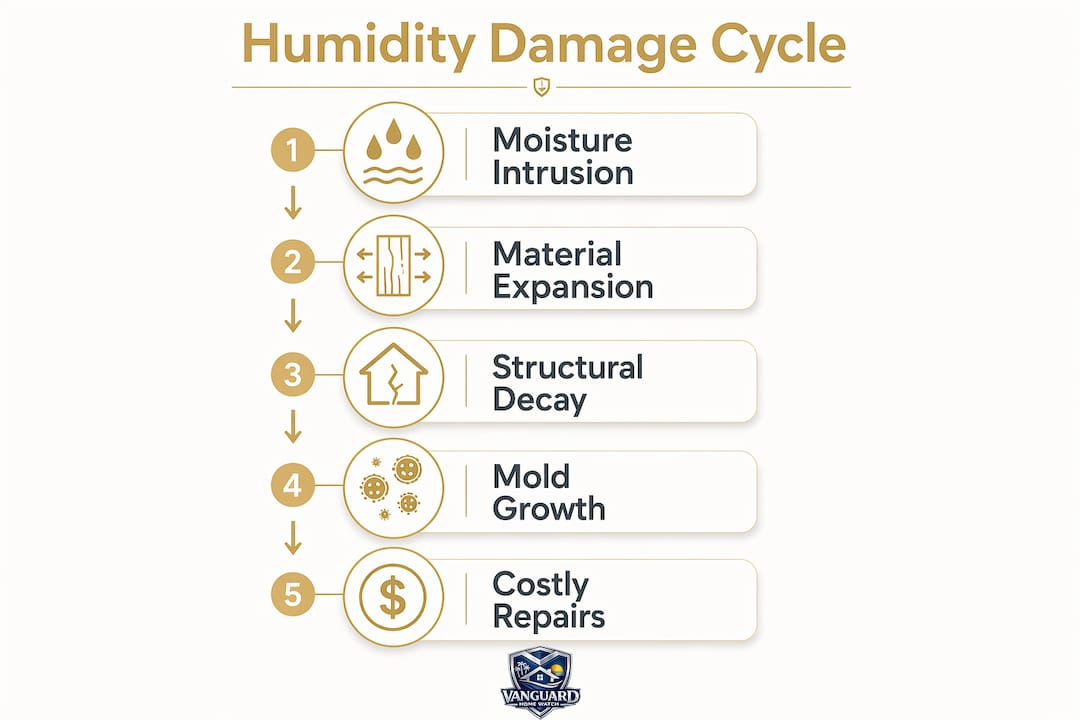
Mold growth in Naples homes is not a slow process. Indoor humidity above 60% consistently results in mold growth within 24–48 hours when spores land on organic materials. Mold spores are always present in the air. The only variable is whether conditions allow them to germinate. In Naples, those conditions arrive quickly and stay long.
Mold colonizes drywall paper, wood framing, insulation batts, and ceiling tiles. The most dangerous growth happens where you cannot see it: inside wall cavities, above drop ceilings, behind baseboards, and inside HVAC ductwork. By the time you smell a musty odor or see discoloration, a colony is already well established.
A common and dangerous misconception is that air drying after a leak is sufficient. Trapped moisture in drywall or insulation will not air dry naturally in Naples. The ambient humidity outside is too high to allow meaningful evaporation. Professional moisture extraction and structural drying equipment are required to prevent mold colonization after any water intrusion event.
The common issues found in vacant Naples homes almost always include hidden mold that started from a minor leak or HVAC failure that went undetected for weeks. Early detection is the only reliable way to avoid a full remediation project.
Pro Tip: A digital hygrometer costs less than $30 and gives you a real-time indoor humidity reading. Place one in each bedroom, the main living area, and any enclosed storage space. If any reading exceeds 60%, act immediately.
Does coastal salt air make plumbing corrosion worse in Naples?
Salt air compounds the damage that humidity causes on its own. Coastal environments like Naples accelerate plumbing pipe corrosion by up to 40% compared to inland homes, due to the combined effect of high humidity and salt-laden air. That is not a minor difference. It means pipes, fittings, and fixtures in Naples homes reach the end of their service life significantly sooner than the manufacturer’s specifications suggest.
Condensation on cold water pipes creates a persistent wet surface. That surface collects airborne salt particles, which accelerate oxidation on copper, galvanized steel, and even some brass fittings. Microbial growth on pipe exteriors follows, which further degrades protective coatings and accelerates pinhole leaks.
| Factor | Coastal Naples homes | Inland homes |
|---|---|---|
| Salt air exposure | High, year-round | Minimal |
| Corrosion rate | Up to 40% faster | Baseline rate |
| Condensation on pipes | Frequent | Seasonal |
| Pipe inspection frequency needed | Every 12 months | Every 2–3 years |
| Risk of pinhole leaks | Elevated | Standard |
Pro Tip: Schedule a professional plumbing inspection every 12 months in Naples. Ask the plumber specifically to check pipe exteriors for pitting, discoloration, and signs of microbial growth, not just for active leaks.
What humidity control strategies actually prevent home damage in Naples?
The target indoor relative humidity for a Naples home is 30%–50%. Indoor humidity must not exceed 60% for extended periods without triggering mold risk. Achieving that target in Southwest Florida requires more than a standard air conditioner running on a basic schedule.
Setting your thermostat between 74°F and 78°F keeps your HVAC system cycling consistently, which is how it removes moisture from the air. A thermostat set too high allows the system to run less frequently, and humidity climbs during those off cycles. The goal is consistent run time, not just temperature control.
Standard bathroom and laundry exhaust fans are insufficient to control whole-home humidity in Naples’ climate. Moisture infiltrates continuously through walls, windows, and doors. A whole-home dehumidifier integrated with your HVAC system is the most reliable solution for maintaining consistent indoor humidity levels.
Completely shutting off the AC in a vacant home causes indoor humidity and temperature to spike rapidly, creating ideal mold conditions within days. This is one of the most common and costly mistakes seasonal homeowners make. The snowbird home checklist for Naples addresses this directly with specific settings for unoccupied periods.
Effective humidity management for Naples homes requires these steps:
- Keep the AC set to 78°F or lower when the home is vacant, never turn it off completely
- Install a whole-home dehumidifier if your AC alone cannot maintain humidity below 60%
- Check and replace HVAC air filters every 30–60 days during high-humidity months
- Seal gaps around windows, doors, and plumbing penetrations to reduce moisture infiltration
- Run bathroom and kitchen exhaust fans during and after use, but do not rely on them for whole-home control
- Monitor indoor humidity with hygrometers in multiple rooms
How can you detect hidden moisture before visible damage appears?
Visual inspection alone is not enough to catch moisture problems in Naples homes. Thermal imaging and hygrometers detect hidden moisture behind walls and under flooring where mold grows before any visible signs appear. A wall can look perfectly normal while harboring a mold colony that has been growing for weeks inside the cavity.
Professional mold inspectors use thermal imaging cameras to identify temperature differentials that indicate moisture accumulation. They follow up with pin-type or non-invasive moisture meters to confirm the reading and determine the extent of saturation. Lab testing of air samples or surface swabs identifies the specific mold species present, which determines the remediation approach required.
Here is the process for a thorough moisture assessment:
- Conduct a hygrometer survey. Record readings in every room, including closets and storage areas. Flag any room above 55% RH for closer inspection.
- Perform a visual inspection. Look for staining, discoloration, bubbling paint, warped materials, and musty odors.
- Use thermal imaging. A certified inspector scans walls and ceilings for cold spots that indicate moisture accumulation.
- Confirm with moisture meters. Non-invasive meters verify moisture content in drywall and wood without causing damage.
- Test air quality. If mold is suspected, collect air samples for lab analysis to identify species and spore counts.
- Document and act. Any confirmed moisture intrusion requires professional drying before remediation. Do not wait.
Home watch inspections in Naples that include humidity monitoring catch these issues between your visits, giving you the earliest possible warning before minor moisture becomes a major remediation project.
Key Takeaways
Naples homes face accelerated mold growth, structural material decay, and plumbing corrosion because coastal humidity and salt air create conditions that standard home maintenance alone cannot address.
| Point | Details |
|---|---|
| Mold grows fast | Indoor humidity above 60% triggers mold colonization within 24–48 hours in Naples. |
| Materials degrade structurally | Persistent moisture warps wood, softens drywall, and causes premature paint failure. |
| Salt air accelerates corrosion | Coastal conditions increase plumbing pipe corrosion rates by up to 40% in Naples. |
| AC settings matter for vacant homes | Never shut off AC completely; keep it set at 78°F or lower to prevent humidity spikes. |
| Detection requires more than eyes | Thermal imaging and moisture meters find hidden moisture before visible damage appears. |
What I’ve learned about Naples humidity that most homeowners find out too late
After walking through Naples homes on a weekly basis, I can tell you that the most expensive damage we find is never from dramatic events. It is from slow, invisible moisture accumulation that nobody noticed because the home looked fine from the outside.
The biggest misconception I see is that seasonal homeowners believe turning off the AC saves money. It does not. What it actually does is turn a closed home into a humidity chamber. Interior closets, sealed rooms, and spaces with poor air circulation reach dangerous humidity levels within days during a Naples summer. By the time the owner returns in the fall, they are looking at mold remediation costs that dwarf any savings from the power bill.
The second thing I see consistently is homeowners relying on a single exhaust fan or a portable dehumidifier to manage whole-home moisture. That approach works in Ohio. It does not work in Southwest Florida, where the outdoor dew point is already above 70°F and moisture is pushing through every gap in the building envelope. You need a whole-home system, and you need it maintained.
What actually works is a combination of consistent HVAC operation, whole-home dehumidification, and regular professional inspections by someone who knows what to look for. The annual home maintenance schedule for Naples homes we recommend to our clients builds these checks into a calendar so nothing gets missed. Humidity in Naples is a year-round threat. Treating it as a seasonal concern is how homes get damaged.
— Joseph
How Vanguard Home Watch LLC protects your Naples home from humidity damage
Catching humidity problems early is the difference between a $200 fix and a $20,000 remediation. Vanguard Home Watch LLC provides weekly visual inspections of vacant and seasonal homes throughout Naples, North Naples, and Ave Maria, specifically designed to identify HVAC failures, humidity concerns, water intrusion, and mold activity before they escalate.

Every inspection includes a detailed digital report with photos delivered directly to you, so you always know the condition of your home regardless of where you are. Joseph and Elizabeth Vangelakos personally oversee every client relationship, and we are fully insured, bonded, background checked, and accredited by the National Home Watch Association (NHWA). If you own a home in Naples and you are not there to watch it, schedule a home watch inspection and give yourself real peace of mind.
FAQ
What indoor humidity level is safe for a Naples home?
Indoor relative humidity should stay between 30% and 50%, and must never exceed 60% for extended periods. Above 60%, mold can begin colonizing organic materials within 24–48 hours.
Can I turn off my AC when my Naples home is vacant?
No. Shutting off the AC completely causes indoor humidity to spike rapidly, creating mold-friendly conditions within days. Keep the thermostat set at 78°F or lower at all times.
How does salt air affect my home’s plumbing in Naples?
Coastal salt air combined with high humidity accelerates pipe corrosion by up to 40% compared to inland homes. Annual professional plumbing inspections are the standard recommendation for Naples properties.
Is a portable dehumidifier enough for a Naples home?
Portable and room-level dehumidifiers are insufficient for whole-home humidity control in Naples. The climate requires a whole-home dehumidifier integrated with your HVAC system to maintain safe indoor humidity levels consistently.
How do professionals find mold that isn’t visible?
Certified inspectors use thermal imaging cameras to detect moisture accumulation behind walls and under floors, followed by moisture meters and air quality lab testing to confirm the presence and species of mold growth.

