A home watch service is a scheduled, professional inspection of your unoccupied property to detect damage, security threats, and maintenance failures before they become costly emergencies. For absentee homeowners and seasonal residents, the right visit frequency is not a preference. It is a decision with direct consequences for your insurance coverage, your property’s condition, and your peace of mind. This home watch service frequency comparison breaks down the three standard options: weekly, bi-weekly, and monthly visits, and explains exactly which conditions call for which schedule.
What is a home watch service frequency comparison?
Home watch service frequency comparison is the process of evaluating weekly, bi-weekly, and monthly inspection schedules against your property’s specific risk profile. The industry term for this process is “visit frequency planning,” and the National Home Watch Association (NHWA) recognizes it as a core component of professional service design. Most providers, including Vanguard Home Watch LLC in Naples, Florida, structure their plans around these three tiers, with weekly visits as the baseline recommendation for vacant homes in high-risk climates.
The stakes of getting this wrong are significant. Typical undetected water damage leads to $5,000 to $25,000 in remediation costs, far exceeding the annual cost of a professional watch plan. That figure does not account for denied insurance claims, which are a real risk when visits are too infrequent to satisfy your policy’s vacancy clause.
Why weekly visits are the standard for most vacant homes
Weekly inspections are the industry-standard recommendation for vacant homes in humid climates like Florida, and the reasoning is grounded in biology and insurance law, not just caution. Mold can establish itself in as little as 48 hours after HVAC failure in a humid environment. A bi-weekly schedule means a failed air conditioner could go undetected for 14 days, turning a $300 service call into a full remediation project.

Florida’s climate makes this especially urgent. Southwest Florida properties face heat, humidity, tropical storms, and pest pressure simultaneously. A weekly visit catches the early signs: a dripping pipe under a sink, a tripped breaker cutting power to the HVAC, standing water near a foundation, or evidence of rodent entry. These are not dramatic failures. They are the quiet, incremental problems that compound into serious damage when no one is watching.
Insurance is the second reason weekly visits matter. Most homeowner insurance policies include vacancy clauses that void coverage if homes remain uninspected for 30 to 60 consecutive days. Professional home watch reports with timestamped, GPS-verified photos satisfy those clauses and preserve your claim eligibility. A neighbor’s informal walkthrough does not.
The cost of weekly professional visits runs approximately $100 to $200 per month, totaling $700 to $1,400 annually. That is a fraction of what a single undetected water leak or mold outbreak costs to remediate. For high-risk properties, including waterfront homes, older construction, and properties with aging HVAC systems, weekly visits are not a premium option. They are the minimum responsible standard.
- Waterfront and coastal homes face accelerated corrosion, moisture intrusion, and storm surge risk
- Older homes with aging plumbing and electrical systems have higher failure rates during vacancy
- Properties with pools require weekly checks to prevent equipment failure and water quality issues
- Homes in active storm seasons need post-event inspections within 24 to 48 hours of a weather event
- Long-term vacancies of six months or more increase cumulative risk at every point in the property
Pro Tip: Ask your insurance carrier directly whether your policy includes a vacancy clause and what inspection frequency it requires. Get the answer in writing, then match your home watch schedule to that requirement.
When bi-weekly or monthly visits might be suitable
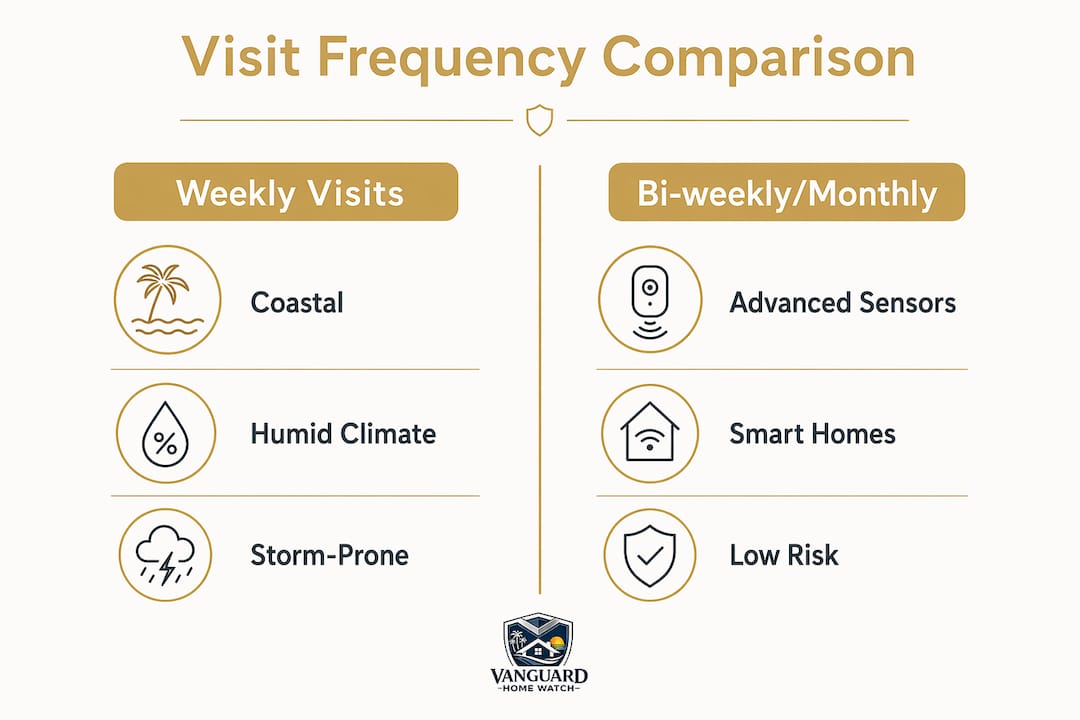
Bi-weekly and monthly home watch schedules are appropriate for a narrower set of circumstances, and the tradeoffs are real. Properties with modern smart monitoring and lower inherent risk can consider bi-weekly visits starting at around $100 per month, but the reduced frequency comes with an acknowledged increase in exposure time between inspections.
The conditions that make less frequent visits defensible include: a property equipped with leak detection sensors, smart thermostats, and security cameras; a condo or gated community with on-site management and maintenance staff; a shorter vacancy period of two to three months in a mild season; or an inland property without coastal exposure or flood risk. Even in these cases, bi-weekly is generally the floor. Monthly visits leave too wide a window for problems to escalate undetected.
| Visit frequency | Best suited for | Key tradeoff |
|---|---|---|
| Weekly | Coastal, humid, storm-prone, long-vacant homes | Higher cost, maximum protection |
| Bi-weekly | Inland condos, smart-monitored, shorter vacancies | Moderate cost, increased detection window |
| Monthly | Low-risk, short-term vacancies with on-site staff | Lowest cost, highest exposure risk |
Insurance implications shift significantly at lower frequencies. Some policies require inspections at specific intervals, and a monthly schedule may not satisfy those terms. Before reducing visit frequency to save money, review your policy’s vacancy clause and confirm in writing that your chosen schedule maintains full coverage.
Pro Tip: Smart home technology is a useful supplement to professional visits, not a substitute. Sensors detect conditions but cannot turn off a water valve, coordinate a repair vendor, or verify that a door was properly secured after a storm.
How climate, property type, and usage patterns dictate frequency
Homewatch frequency decisions should consider home age, climate risks, building type, and owner absence length rather than applying a fixed schedule. This is the framework that separates a genuinely protective plan from a generic one. Two homes on the same street can warrant different visit frequencies based on their individual risk profiles.
Climate is the most immediate variable. Southwest Florida’s combination of heat, humidity, and hurricane season creates conditions where problems develop faster than in temperate regions. A leaking roof in a dry climate might cause staining over weeks. The same leak in Naples during summer can produce active mold growth within two days. Freezing climates present the opposite risk: burst pipes during cold snaps require rapid detection that only frequent visits provide.
Property-specific factors compound climate risk:
- Age and construction: Homes built before 1990 often have galvanized plumbing, older electrical panels, and less effective vapor barriers, all of which increase failure probability during vacancy
- Location: Coastal and waterfront properties face salt air corrosion, higher humidity, and direct storm exposure that inland properties do not
- HVAC system age: Systems older than 10 years are statistically more likely to fail during peak demand periods, which in Florida means summer
- Pool and irrigation systems: These require regular operational checks that go beyond what a sensor can verify
- Roof condition: An aging roof needs eyes on it after every significant rain event, not just once a month
Owner usage patterns matter too. A homeowner who visits their Naples property every six weeks provides natural interim checks. A full seasonal resident absent from May through November has no such buffer. The risk profile of a property should dictate home watch frequency more than fixed rules, and that profile changes with the season, the weather, and the owner’s own schedule.
Post-event inspections are a critical and often overlooked component. Professional visits after storms or outages provide physical verification and vendor coordination that no sensor or camera can replicate. A tropical storm that passes through Naples on a Tuesday needs a trained set of eyes on your property by Wednesday morning, regardless of your standard visit schedule.
Professional home watch vs. alternatives: a direct comparison
Professional home watch provides accountability, documented inspections, and emergency vendor coordination that technology and neighbors cannot replace. This is not a marketing claim. It is a functional distinction with legal and financial consequences.
A neighbor checking your home is a favor, not a service. There is no documentation, no liability, no professional standard, and no insurance backing. If your neighbor misses a water leak and you file a claim, your insurer will ask for proof of inspection. A text message saying “looks fine” does not qualify. Professional home watch services provide insurance-backed documentation and accountability that informal solutions simply cannot achieve.
Electronic monitoring fills a different role. Smart sensors, cameras, and leak detectors are genuinely useful tools. They alert you to conditions in real time. But electronic monitoring cannot replace the human element of physically inspecting, securing, and responding to property issues. A camera shows you water on the floor. A professional home watch inspector turns off the supply valve, photographs the damage, contacts a licensed plumber, and sends you a timestamped report within hours.
| Monitoring type | Documentation | Emergency response | Insurance compliance | Frequency flexibility |
|---|---|---|---|---|
| Professional home watch | Yes, photo reports | Yes, vendor coordination | Yes, meets vacancy clauses | Weekly, bi-weekly, monthly |
| Neighbor or friend | No | Limited | No | Inconsistent |
| Smart technology only | Alerts only | No physical response | Typically insufficient | Continuous but passive |
The benefits of home watch services extend beyond detection. Accredited NHWA members like Vanguard Home Watch LLC carry insurance, pass background checks, and operate under professional standards that protect both the homeowner and the property. That accountability structure is what makes professional visits worth the cost, particularly when the alternative is a denied insurance claim on a $20,000 water loss.
For snowbirds and seasonal residents researching why home watch services matter, the comparison is straightforward. Informal solutions are better than nothing. Professional services are better than informal solutions. And the right frequency of professional visits is the variable that determines how much protection you actually receive.
Key takeaways
The right home watch frequency is determined by climate, property risk, and insurance requirements, with weekly visits as the defensible standard for most vacant Florida homes.
| Point | Details |
|---|---|
| Weekly visits are the baseline | Humid, storm-prone, and coastal properties require weekly inspections to catch fast-developing issues. |
| Insurance compliance drives frequency | Vacancy clauses in most policies require documented visits every 30 to 60 days at minimum. |
| Bi-weekly suits lower-risk properties | Smart-monitored inland condos with shorter vacancies may qualify for bi-weekly schedules. |
| Professional visits outperform alternatives | Documented reports, vendor coordination, and NHWA accreditation provide protection neighbors and sensors cannot. |
| Risk profile beats fixed rules | Home age, location, HVAC condition, and absence length should all factor into your visit schedule. |
What I’ve learned from watching homes others thought were fine
After years of inspecting vacant properties in Naples and the surrounding area, the pattern I see most often is not neglect. It is underestimation. Homeowners who are thoughtful, careful people genuinely believe their property is lower risk than it is. They installed a smart thermostat. They have a neighbor with a key. They were only gone for six weeks. And then we walk in and find a slow leak under the kitchen sink that has been running for two weeks, or an HVAC unit that failed silently and left the interior at 90 degrees for days.
The homes that surprise me most are the newer ones. Owners of recently built properties often assume modern construction means fewer problems. In reality, newer homes in Florida still face the same humidity, the same storm exposure, and the same pest pressure as older ones. The plumbing is newer, but the risk environment is identical.
My honest recommendation: when you are uncertain between two frequency options, choose the more frequent one. The cost difference between weekly and bi-weekly visits is modest. The cost difference between catching a problem early and discovering it after two weeks of unchecked damage is not. Florida homes need weekly checks not because it is a rule, but because the climate makes it the rational choice. And always ask your provider for a tailored plan based on your specific property, not a generic package.
— Joseph
Protect your Naples home with the right visit schedule
Vanguard Home Watch LLC offers customizable inspection plans for absentee homeowners and seasonal residents throughout Naples, North Naples, and Ave Maria, Florida. Whether your property calls for weekly visits during hurricane season or a bi-weekly schedule during lower-risk months, we build a plan around your home’s specific needs.
Every visit includes a detailed digital report with photos, HVAC and moisture checks, security verification, and direct coordination with licensed vendors when issues arise. As fully insured, bonded, and NHWA-accredited professionals, we provide the documentation your insurance carrier requires. Learn exactly what a home watch inspector does on every visit, or contact us directly to schedule a free consultation and build a frequency plan that fits your property and your peace of mind.
FAQ
What is the recommended home watch visit frequency for Florida homes?
Weekly visits are the industry standard for vacant Florida homes due to the state’s humidity, heat, and storm exposure. Mold can develop within 48 hours of an HVAC failure, making weekly detection the minimum responsible schedule for most properties.
Does my homeowner insurance require a specific inspection frequency?
Most policies include vacancy clauses that void coverage if a home goes uninspected for 30 to 60 consecutive days. Professional home watch reports with timestamped, GPS-verified photos are the documentation insurers require to maintain claim eligibility.
Can smart home technology replace professional home watch visits?
Smart sensors and cameras supplement professional visits but cannot replace them. Technology alerts you to conditions; a professional inspector physically responds, secures the property, and coordinates licensed repair vendors on your behalf.
How do I choose between weekly and bi-weekly home watch service?
Base the decision on your property’s risk profile: climate exposure, home age, HVAC condition, vacancy length, and your insurance policy’s requirements. Coastal and long-vacant homes warrant weekly visits; lower-risk inland properties with smart monitoring may qualify for bi-weekly schedules.
What does a professional home watch report include?
A professional report includes timestamped photos, observations on HVAC function, moisture and humidity levels, pest activity, security status, and any maintenance concerns identified during the visit. This documentation supports insurance claims and provides a clear record of property condition over time.

