Coordinating home watch with property management is the most reliable way for Naples seasonal homeowners to protect their properties during extended absences. These are two distinct services, and absentee owners need both working together. Home watch focuses on preventative inspections of owner-occupied and second homes, while property management targets tenant and rental operations. Vanguard Home Watch LLC, an accredited member of the National Home Watch Association (NHWA), delivers the inspection and documentation layer that makes this coordination work. Naples’ heat, humidity, and hurricane season create conditions where an unmonitored home can deteriorate quickly.
How to coordinate home watch and property management effectively
The first step is understanding what each service actually does. Property management targets rental properties, focusing on tenants and leases. Home watch is designed for owner-occupied and second homes, with an emphasis on preventative maintenance and early detection. Confusing the two leads to coverage gaps that cost homeowners significantly.
Before you can coordinate these services, you need the right foundation in place.

What you need before you start
Gather the following before contacting any provider:
- Property details: square footage, age of HVAC systems, pool equipment specs, and alarm codes
- Access instructions: key locations, gate codes, and garage entry procedures
- Vendor contacts: your preferred plumber, electrician, HVAC technician, and landscaper
- Insurance documents: your residential property insurance policy and HOA rules
- Emergency contacts: a local neighbor or trusted contact who can respond if needed
Provider vetting is non-negotiable. Reputable home watch providers hold NHWA accreditation, which requires proper insurance, bonding, and staff background checks. Hiring an unvetted provider exposes you to liability and unreliable reporting.
| Document or Tool | Purpose |
|---|---|
| Digital inspection platform | Delivers time-stamped photo reports after each visit |
| Vendor contact list | Enables fast scheduling when issues are found |
| Property insurance policy | Required for claims documentation and HOA compliance |
| NHWA accreditation certificate | Confirms provider meets industry vetting standards |
| Communication channel (email or app) | Keeps homeowner, home watch, and property manager aligned |
Pro Tip: Set up a shared digital folder with your property details, insurance documents, and vendor contacts before your first season away. Give access to both your home watch provider and property manager so everyone works from the same information.
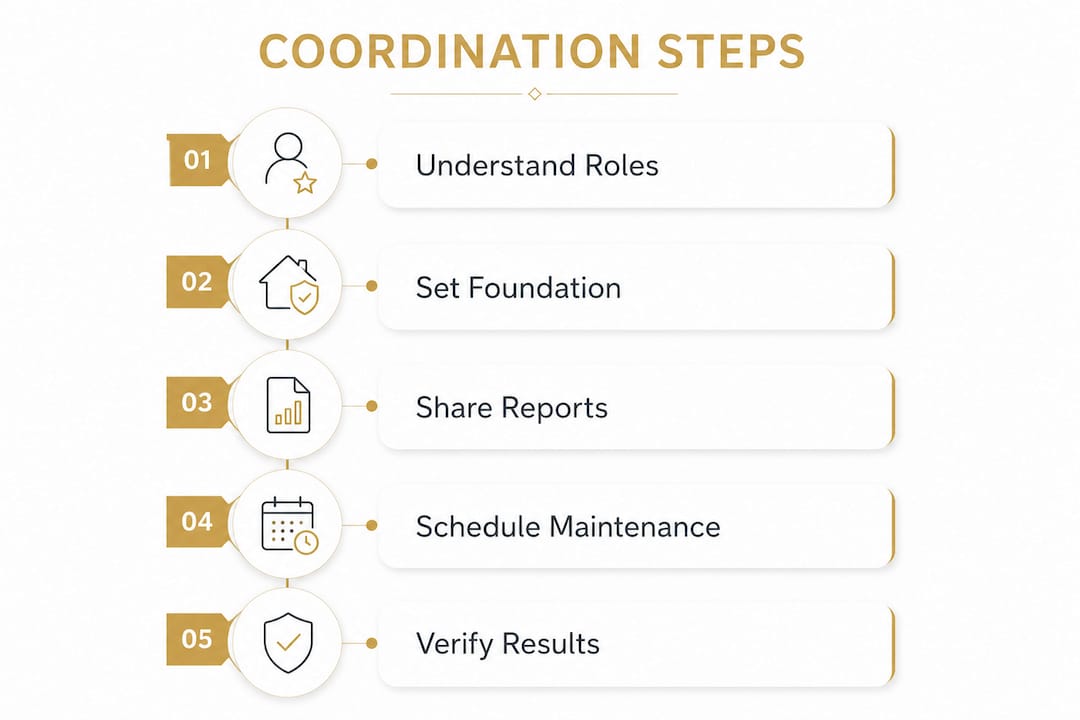
Step-by-step process for coordinating these services in Naples
A clear process eliminates confusion between your home watch provider and property manager. Home watch professionals typically vet, schedule, and supervise 10–15 specialized vendors to ensure quality and documentation. They do not perform repairs themselves. That distinction matters when assigning responsibilities.
Follow these steps to build a working coordination system:
Define each provider’s role in writing. Specify that home watch handles inspections, documentation, and vendor oversight. Property management handles HOA communications, administrative tasks, and any rental-related functions if applicable.
Set an inspection schedule. Weekly inspections are the standard for Naples homes during the off-season. Vanguard Home Watch LLC conducts weekly visual inspections covering water leaks, HVAC performance, humidity levels, mold signs, pest activity, storm damage, and security concerns.
Establish a reporting protocol. After each inspection, your home watch provider should deliver a digital inspection report with time-stamped photos. Require that your property manager receives a copy of any report flagging a maintenance issue.
Create an emergency response chain. Define who gets called first when a serious issue is found. Home watch identifies the problem. Property management or a designated vendor handles the repair. You approve costs above a set threshold.
Schedule seasonal transitions. Coordinate your home watch provider and property manager to handle your arrival and departure. Home watch services manage HOA notices, package receipt, and seasonal openings and closings, giving you a local presence without requiring you to be there.
Review reports monthly. Look for recurring issues across multiple inspection reports. A pattern of high humidity readings, for example, signals an HVAC problem before it becomes a mold claim.
Reassess annually. At the end of each season, review your providers’ performance, update vendor contacts, and adjust your inspection frequency if your property’s needs have changed.
Pro Tip: Ask your home watch provider to copy your property manager on every inspection report automatically. This removes a manual step and keeps both parties informed without extra effort from you.
What are the most common mistakes when coordinating these services?
The most frequent mistake is leaving roles undefined. When both providers assume the other is handling vendor scheduling, repairs get delayed and problems worsen. Vetted vendors and clear communication reduce misdiagnosis, repeated work, and delays in repairs during absentee management.
Watch for these specific pitfalls:
- Overlapping authority: Two providers contacting the same vendor independently creates confusion and duplicate charges.
- Delayed reporting: A home watch provider who sends reports weekly but flags urgent issues on the same schedule as routine ones creates dangerous delays.
- Poor documentation: Without time-stamped photos, you cannot support an insurance claim or prove a vendor completed work correctly.
- Unvetted vendors: Allowing either provider to hire contractors without background checks or licensing verification exposes your property to substandard work.
“Professional home watch acts as an early-warning system, detecting issues early, coordinating necessary repairs promptly, and preventing major property damage.”
When a problem is found, the troubleshooting sequence should be consistent. Home watch identifies and documents. Property management or the homeowner authorizes a repair. A vetted vendor completes the work. Home watch conducts a follow-up inspection to confirm the fix. This four-step loop prevents issues from falling through the cracks.
How do you verify that coordination is working over time?
Effective coordination shows up in your inspection reports. Technical home watch inspections use protocols checking mold, pest signs, and humidity, supplemented by digital photo documentation to track property condition over time. If your reports show consistent readings and no recurring issues, your system is working.
Use this framework to evaluate your coordination on an ongoing basis:
| Verification Method | What It Tells You |
|---|---|
| Monthly report review | Identifies recurring issues before they escalate |
| Vendor invoice audit | Confirms repairs were authorized and completed correctly |
| HOA compliance check | Verifies no unresolved notices from the association |
| Insurance claim readiness | Confirms documentation meets your policy’s requirements |
| Annual provider review | Assesses whether current providers still meet your needs |
Seasonal maintenance scheduling is another key indicator. A well-coordinated system produces a Naples home maintenance schedule that anticipates your property’s needs rather than reacting to failures. Pre-hurricane season checks, post-storm inspections, and HVAC servicing before summer heat all belong on a proactive calendar.
Vanguard Home Watch LLC delivers detailed digital reports with photos after every visit. Those reports serve a dual purpose: they give you real-time visibility into your property’s condition, and they create a documented record that supports residential property insurance claims and HOA compliance reviews.
Pro Tip: Save every inspection report in a dedicated folder organized by date. If you ever need to file an insurance claim, a chronological record of your property’s condition is one of the strongest forms of evidence you can provide.
When to reassess your providers is straightforward. If reports are late, documentation is thin, or vendors are not being followed up on, those are signals to have a direct conversation or find a replacement. Coordination only works when both providers are accountable.
Key Takeaways
Coordinating home watch with property management requires clear role definitions, consistent documentation, and vetted providers working from a shared communication system.
| Point | Details |
|---|---|
| Define roles in writing | Assign inspection duties to home watch and administrative tasks to property management before the season starts. |
| Require NHWA-accredited providers | Accreditation confirms insurance, bonding, and background checks are in place. |
| Use digital reports as your record | Time-stamped photo reports support insurance claims and track property condition over time. |
| Build a four-step repair loop | Home watch identifies, management authorizes, vendor repairs, home watch confirms. |
| Review reports monthly | Recurring patterns in reports reveal developing problems before they become costly failures. |
What I’ve learned from coordinating these services in Naples
After years of working with seasonal homeowners in Naples, the pattern I see most often is this: owners set up their services at the start of the season and then assume the coordination runs itself. It does not.
The homeowners who get the most value from coordinated home watch and property management treat it as an ongoing partnership, not a one-time setup. They read their inspection reports. They ask questions when something looks different. They update their vendor list when a contractor retires or moves. That level of engagement takes maybe 30 minutes a month, and it consistently prevents the kind of emergency repairs that cost thousands.
Naples’ climate is genuinely unforgiving for vacant homes. High humidity between june and september creates conditions where mold can establish itself in weeks, not months. An HVAC unit that fails silently over a long weekend can turn a manageable repair into a full remediation project. Proactive management saves significant money by catching problems months before serious failure occurs. That is not a theoretical benefit. We see it in our reports every season.
My strongest recommendation is to select providers who know Naples specifically. A home watch company familiar with the local HOA rules, the common pest pressures in Southwest Florida, and the post-hurricane inspection requirements will serve you far better than a generic national service. Local knowledge is not a soft benefit. It is a practical advantage that shows up in faster vendor response times and more accurate issue identification.
— Joseph
Vanguard Home Watch LLC: property care built for Naples homeowners
Vanguard Home Watch LLC serves seasonal and absentee homeowners across Naples, North Naples, and Ave Maria with weekly inspections, detailed digital reports, and trusted vendor coordination.
Every inspection covers water leaks, HVAC performance, humidity, mold, pest activity, storm damage, and security concerns. Reports include time-stamped photos delivered after every visit, giving you a clear record of your property’s condition from anywhere in the country. As an NHWA-accredited, fully insured, and bonded company, Vanguard Home Watch LLC meets the industry’s highest vetting standards. Explore our Naples luxury home watch services to find the right inspection plan for your property, or learn more about what a home watch inspector does during each visit.
FAQ
What is the difference between home watch and property management?
Property management focuses on tenants and leases, while home watch is designed for owner-occupied and second homes with an emphasis on preventative maintenance and inspections. Both services serve different functions and work best when coordinated together.
How often should a home watch inspection happen in Naples?
Weekly inspections are the standard for Naples homes during the off-season, given the region’s heat, humidity, and hurricane exposure. Vanguard Home Watch LLC conducts weekly visual inspections and delivers a digital report with photos after every visit.
What should a home watch inspection report include?
A professional report includes time-stamped photos and documentation covering mold, pest signs, humidity readings, HVAC status, water leaks, and any security concerns. This record supports insurance claims and HOA compliance reviews.
Do home watch providers perform repairs?
Home watch professionals do not perform repairs. They identify issues and coordinate vendors, supervising the repair process and conducting follow-up inspections to confirm the work was completed correctly.
How do I verify that my home watch provider is legitimate?
Confirm that your provider holds NHWA accreditation, which requires proper insurance, bonding, and staff background checks. Ask for proof of accreditation and verify it directly with the National Home Watch Association before signing any agreement.

