Home watch is defined as a scheduled visual inspection of an unoccupied property to identify obvious issues before they become costly problems. The National Home Watch Association sets the industry standard: inspections occur every 7–14 days, depending on property risk and insurance requirements. This is not a security alarm, a neighbor favor, or a house-sitting arrangement. The role of home watch during extended travel is to provide professional, documented oversight that protects your property, satisfies your insurer, and gives you genuine peace of mind while you are away. Vanguard Home Watch LLC delivers exactly that service across Naples, North Naples, and Ave Maria, Florida.
What does the role of home watch during extended travel actually cover?
Professional home watch services go well beyond locking the door and hoping for the best. A trained inspector walks through your property on a scheduled basis and checks every system that can fail silently while you are away.
A standard inspection covers:
- Interior systems: Plumbing for leaks or drips, HVAC operation and filter condition, water heater status, and signs of humidity or mold
- Exterior condition: Roof, gutters, doors, windows, and any storm-related damage
- Security: Locks, garage doors, and signs of unauthorized entry
- Environmental threats: Pest activity, standing water, and odors that signal hidden moisture
- Utilities: Breaker panels, smoke detectors, and any smart-home alerts that need human verification
Professional home watch services also use GPS-verified visit logs, photo documentation, and digital reporting tools to create a transparent record of every inspection. That record matters to your insurance company and to you.
The critical distinction is what home watch is not. Home watch is not house sitting or property management. It is structured oversight focused on early detection and prevention, not daily operations or concierge tasks. An alarm system monitors for intrusion and fire. It does not check whether a pipe is weeping behind a cabinet or whether your HVAC has stopped running in Florida’s summer heat.

Pro Tip: Ask any home watch provider to show you a sample inspection report before you sign a contract. A professional service produces a detailed, photo-supported digital report after every visit. If the sample looks like a handwritten checklist, keep looking.
How does home watch prevent costly damage and support insurance claims?
The primary value of home watch is catching small problems before they become large ones. Routine inspections dramatically improve outcomes by identifying issues while they are still in the minor-repair phase. A slow leak found on week one costs a service call. The same leak found after six weeks of vacancy can cost tens of thousands in water damage, mold remediation, and flooring replacement.
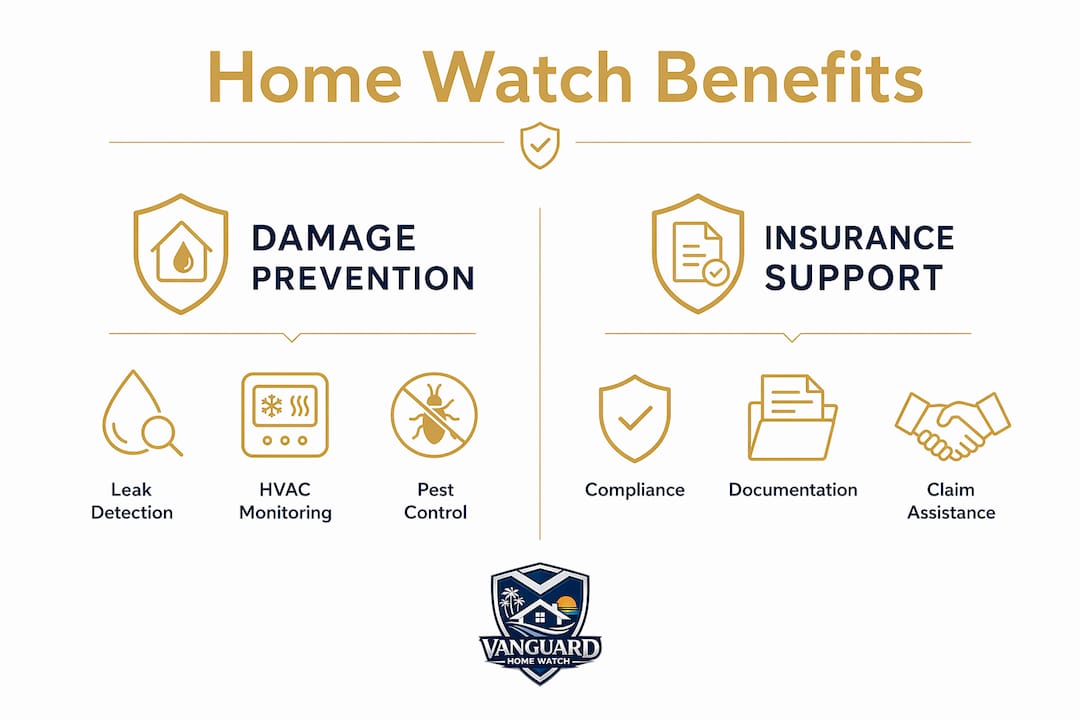
Insurance compliance is an equally important reason to hire a professional. Many homeowners assume their policy covers a vacant home indefinitely. It does not. Vacancy clauses can void coverage if a property goes unmonitored for 30–60 days. Insurers require documented, periodic inspections to maintain that coverage. A neighbor’s informal walk-through rarely satisfies that standard.
| Risk scenario | What home watch catches | Outcome without monitoring |
|---|---|---|
| Plumbing leak | Detected within 7–14 days | Weeks of water damage, mold growth |
| HVAC failure | Caught on next scheduled visit | Humidity spike, mold risk, equipment damage |
| Pest intrusion | Identified during interior inspection | Infestation spreads unchecked |
| Storm damage | Documented immediately after event | Delayed claim, disputed coverage |
| Security breach | Flagged and reported same visit | Ongoing vulnerability, potential theft |
Time-stamped, photo-supported inspection reports also serve as evidence when you file a claim. An insurer is far more likely to honor a claim when you can show documented proof that the property was professionally monitored and that the damage occurred between two verified inspection dates.
Pro Tip: Request that your home watch provider note your insurance policy’s vacancy clause requirements before your first visit. A good provider will schedule visits to match your policy’s inspection interval, not just their own convenience.
Home watch professionals also coordinate repairs on your behalf. They act as your advocate, connecting you with licensed tradespeople and overseeing the work without performing unauthorized repairs themselves. That coordination saves you from managing contractors remotely and ensures the right professionals handle every issue.
How do you choose the right home watch service?
Selecting a home watch provider is a decision that deserves the same care you give to choosing a contractor or financial advisor. The wrong choice leaves you with a false sense of security and no legal protection if something goes wrong.
The non-negotiable qualifications are:
- Accreditation: Look for membership in the National Home Watch Association (NHWA). Accredited members meet defined standards for professionalism and ethics.
- Bonding and liability insurance: A bonded and insured provider protects you financially if an incident occurs during a visit. An uninsured neighbor does not.
- Background checks: Professional providers are background-checked, which matters when someone has access to your home for months at a time.
- Digital documentation: Every visit should produce a written report with photos, delivered to you promptly. This is the standard that separates professional services from informal check-ins.
- Visit frequency: Confirm that the provider’s standard schedule matches your insurance policy’s inspection interval, typically every 7–14 days.
Service frequency matters more than most homeowners realize. A home watch service frequency comparison shows that weekly visits are the preferred standard for high-risk properties, particularly in Florida where heat, humidity, and storm activity create conditions that change fast. Bi-weekly visits may satisfy some insurance policies but leave a longer window for undetected damage.
Avoid the common mistake of treating home watch as a commodity. Homeowners often underestimate the accountability gap between a bonded, insured professional and an informal solution. A neighbor who agrees to check in has no training, no liability, and no legal obligation to document what they see.
Practical steps to prepare your home and get the most from home watch
The effectiveness of any home watch service depends partly on how well you prepare before you leave. A well-prepared property gives your inspector a clean baseline and reduces the chance of avoidable problems.
- Secure all entry points. Lock every door, window, and garage access point. Confirm that sliding doors are pinned or barred, not just latched.
- Shut off the main water supply. Turning off the main water supply before departure eliminates the risk of a burst pipe flooding your home while you are away.
- Set your HVAC to a safe temperature. In Florida, set the thermostat no higher than 80°F to control humidity and protect furnishings. Do not turn the system off entirely.
- Arrange mail and deliveries. A full mailbox or packages on the porch signal vacancy to anyone watching. Use USPS mail hold or forward to a trusted address.
- Provide your inspector with a complete contact list. Include your preferred plumber, electrician, and HVAC technician. Your home watch provider can then call the right person immediately if an issue arises.
- Walk through the property with your inspector before you leave. A pre-departure walkthrough establishes the baseline condition of every room and system. Your inspector knows what “normal” looks like for your specific home.
- Integrate your smart-home devices. Smart thermostats, leak sensors, and security cameras complement professional inspections. They generate alerts between visits, and your home watch provider can respond in person when an alert fires.
Home monitoring while traveling works best as a layered system. Technology handles real-time alerts. Professional inspectors handle physical verification, documentation, and vendor coordination. Neither replaces the other. The value of home watch for absentee owners is that a trained human being physically confirms what sensors can only suggest.
Key Takeaways
Professional home watch is the most reliable method for protecting a vacant property during extended travel because it combines scheduled physical inspections, documented reporting, and vendor coordination in a single accountable service.
| Point | Details |
|---|---|
| Defined inspection frequency | Visits every 7–14 days satisfy most insurance vacancy clauses and catch issues early. |
| Insurance compliance | Time-stamped, photo-supported reports are required by many insurers to maintain coverage on vacant homes. |
| Beyond alarm systems | Home watch detects leaks, HVAC failures, mold, and pest activity that security alarms cannot monitor. |
| Professional accountability | Bonded, insured, NHWA-accredited providers offer legal and financial protection that informal check-ins do not. |
| Pre-travel preparation | Shutting off water, setting HVAC, and briefing your inspector maximizes the effectiveness of every visit. |
What I have learned after years of watching vacant homes
I spent over two decades in law enforcement before founding Vanguard Home Watch LLC with my wife Elizabeth. That background taught me one thing above everything else: most problems are preventable when someone is paying attention on a consistent schedule.
The homeowners who call me after a disaster almost always say the same thing. They assumed their neighbor would notice something, or that their alarm system would catch it, or that nothing would go wrong in just a few months. None of those assumptions held up. A slow leak behind a vanity does not trigger an alarm. A neighbor walking past the front door does not see the HVAC condensate line backing up in the utility closet.
What I find most misunderstood about home watch is the documentation piece. Homeowners focus on the inspection itself, which makes sense. But the written report with photos is often what determines whether an insurance claim gets paid. I have seen claims denied because the homeowner could not prove when damage occurred or that the property was being monitored. A professional report removes that ambiguity entirely.
My honest advice: do not wait until something goes wrong to take extended travel house care seriously. The cost of professional home watch is a fraction of a single water damage claim. More than that, it is the difference between getting a phone call about a minor repair and coming home to a gutted bathroom. Invest in accredited home watch services from a provider who is bonded, insured, and accountable. Your property deserves that standard of care.
— Joseph
Vanguard Home Watch LLC: professional coverage while you travel
Vanguard Home Watch LLC serves homeowners in Naples, North Naples, and Ave Maria, Florida with weekly visual inspections, detailed digital reports, and direct vendor coordination. Every visit is conducted by a background-checked, bonded, and insured professional who is an accredited member of the National Home Watch Association.
We tailor visit frequency to your property’s risk profile and your insurance policy’s requirements. After every inspection, you receive a photo-supported digital report delivered directly to your inbox. If an issue arises, we contact your preferred vendors and oversee the response on your behalf. Learn more about how we protect your home or review our service frequency options to find the right plan before your next trip.
FAQ
What is home watch and how does it differ from house sitting?
Home watch is a scheduled visual inspection of an unoccupied property conducted by a trained, bonded professional, typically every 7–14 days. House sitting involves someone living in the home, which serves a different purpose and does not provide the documented, standardized oversight that insurers require.
Will my homeowner’s insurance cover a vacant property without home watch?
Many policies include vacancy clauses that can void or limit coverage if a home is unmonitored for 30–60 days. Professional home watch with time-stamped, photo-documented reports is the standard most insurers require to maintain coverage during extended absences.
What issues does home watch catch that alarm systems miss?
Home watch inspections detect slow plumbing leaks, HVAC failures, mold growth, pest activity, and humidity problems. Security alarms monitor for intrusion and fire but cannot identify environmental or mechanical issues developing inside the home.
How often should a home watch provider visit my property?
The standard inspection interval is every 7–14 days, depending on your property’s risk level and your insurance policy’s vacancy clause. Florida properties typically benefit from weekly visits due to heat, humidity, and storm exposure.
Does a home watch professional perform repairs during inspections?
Home watch professionals do not perform repairs. They identify issues, document them with photos, and coordinate licensed vendors on your behalf to resolve the problem efficiently while you remain away.

