Home watch is defined as the practice of conducting scheduled, professional inspections of vacant or seasonal properties to satisfy homeowners insurance vacancy clause requirements and prevent claim denials. The role of home watch in homeowners insurance compliance is direct: without documented, regular inspections, Florida insurance carriers can limit or void coverage entirely. Vacancy clauses in most Florida policies trigger after 30–60 days of unoccupied status, making consistent monitoring a financial necessity, not just a convenience. The National Home Watch Association (NHWA) sets the industry standard for professional providers, and Vanguard Home Watch LLC operates under those standards to protect Naples-area homeowners year-round.
How does home watch support homeowners insurance compliance?
Professional home watch services fulfill insurance requirements through a documented inspection protocol that insurers can verify. Every visit produces a time-stamped digital report with photographs, creating an audit trail that stands up to adjuster scrutiny. This is not optional paperwork. Insurers increasingly require digital, time-stamped inspection reports as standard proof of compliance, making traditional paper logs or verbal verification inadequate.
The inspection frequency matters as much as the documentation itself. Most Florida carriers expect inspections at least every 30–60 days, but weekly or bi-weekly visits provide a stronger compliance record and catch problems before they escalate. Vanguard Home Watch LLC conducts weekly visual inspections covering water leaks, HVAC performance, humidity levels, mold indicators, pest activity, storm damage, and security concerns. Each report goes directly to the homeowner with photos after every visit.
Key elements that professional home watch reports must include to satisfy insurance requirements:
- Time-stamped photographs of all interior and exterior areas inspected
- Detailed written checklists covering HVAC, plumbing, windows, doors, and roof condition
- Date and signature of the inspector confirming the visit occurred
- Notes on any issues identified and actions taken or recommended
- Consistent visit frequency matching or exceeding the policy’s stated inspection interval
Pro Tip: Ask your insurance agent to confirm the exact inspection frequency and documentation format your policy requires before your property sits vacant. Policies vary by carrier, and knowing the specific language protects you from surprises at claim time.
NHWA accreditation requires member providers to follow standardized inspection protocols. That consistency is what makes their reports credible to adjusters. A vacant home inspection checklist aligned with Florida policy requirements gives homeowners a clear picture of what each visit must cover.
Why does hiring an insured home watch provider matter?
The difference between a neighbor checking on your home and a certified professional is not just thoroughness. It is liability, documentation, and credibility with your insurer. Insurance adjusters distinguish professional home watch from casual monitoring, and verifiable, time-stamped records are critical during claims. A neighbor’s verbal account carries no weight in a coverage dispute.

The NHWA recommends that home watch providers carry $1 million in general liability coverage with $2 million aggregate limits, plus professional liability insurance. That recommendation exists because homeowners face real exposure if an uninsured provider misses a critical issue that causes damage. Errors and Omissions (E&O) insurance held by the provider protects you if an inspector overlooks something that leads to a loss. Without it, you may be left holding the bill.
Hiring an uninsured or uncertified provider creates three specific risks:
- Claim denial risk: Insurers may reject claims if the inspection record comes from an unqualified source
- Liability gap: If the provider causes accidental damage during a visit, you may have no recourse
- Credibility gap: Adjusters give little weight to informal inspection logs during disputes
Pro Tip: Request a certificate of insurance from any home watch provider before signing a contract. Confirm it includes both general liability and E&O coverage. Vanguard Home Watch LLC is fully bonded, insured, and background checked, and we provide documentation on request.
NHWA accreditation and proper insurance coverage for home watch providers is a growing expectation among Florida carriers. Choosing a certified, insured provider is not just good practice. It is increasingly a condition for your coverage to hold.
What do vacancy clauses require, and how does home watch address them?
Vacancy clauses are standard language in Florida homeowners insurance policies that limit or void coverage when a property sits unoccupied beyond a defined period. Vacancy clauses typically trigger after 30–60 days of inactivity, and the documentation required to avoid claim denial varies by carrier. Homeowners who leave for the summer without arranging inspections often discover this language only after filing a claim.
The table below shows how typical vacancy clause requirements align with professional home watch service deliverables:
| Vacancy clause requirement | How home watch addresses it |
|---|---|
| Inspections every 30–60 days minimum | Weekly or bi-weekly visits exceed the minimum threshold |
| Written documentation of each visit | Digital reports with checklists provided after every inspection |
| Photographic evidence of property condition | Time-stamped photos of all key areas included in every report |
| Notification of damage or hazards | Immediate owner notification with photos when issues are found |
| Qualified inspector conducting visits | NHWA-accredited, bonded, and insured professionals |
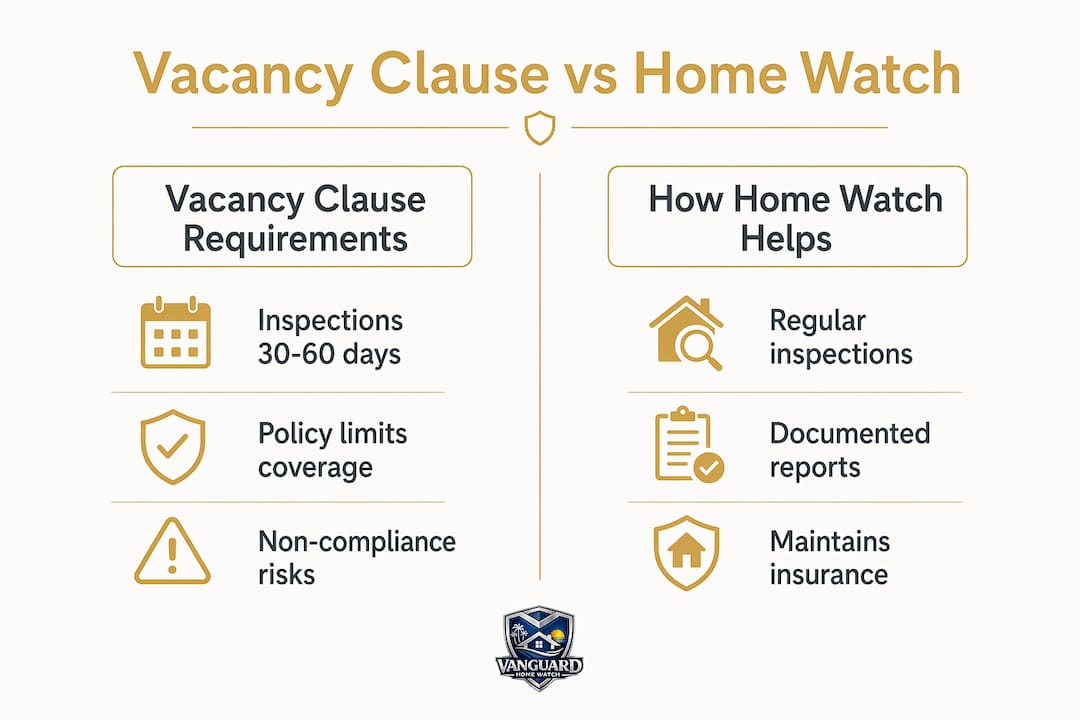
Non-compliance with vacancy clauses carries serious financial consequences. Property exposure due to non-compliance can lead to tens of thousands of dollars in denied claims. A burst pipe or mold outbreak in an unmonitored home can produce losses that an insurer refuses to cover if no inspection record exists.
Property management is not a substitute for home watch in this context. Property management is reactive and tenant-focused, while home watch is proactive inspection designed to satisfy vacancy clause obligations. A property manager handles leases and maintenance requests. A home watch professional conducts scheduled inspections and generates the compliance documentation your insurer requires. The two services solve different problems.
Vacancy clauses vary significantly between carriers, so homeowners must confirm the specific language with their insurance agent. Do not assume your policy matches a neighbor’s. Get the exact inspection frequency and documentation format in writing before your property goes vacant.
What does home watch cost compared to the risk of non-compliance?
Professional home watch in Florida is a measurable investment with a clear risk comparison. Costs typically range from $100 per month for bi-weekly inspections to $200 per month for weekly visits. That translates to roughly $1,200 per year for bi-weekly service and $2,400 per year for weekly coverage.
Set against the cost of a denied insurance claim, those figures are modest. A single water damage event from an undetected pipe leak can run into tens of thousands of dollars in repairs. If the insurer denies the claim because no inspection record exists, the homeowner absorbs the full loss. The math strongly favors professional monitoring.
Beyond insurance compliance, homeowners who invest in professional home watch also detect costly issues early, minimizing losses before they compound. An HVAC failure caught during a weekly visit costs far less to address than the mold remediation that follows two weeks of unchecked humidity. For absentee owners in Florida, this early detection benefit compounds over a full season away.
High-value Florida properties face unique environmental risks, making weekly inspection plans advisable over bi-weekly to prevent and document issues proactively. Naples properties, in particular, face humidity, storm exposure, and pest pressure that accelerate damage in unmonitored homes. The frequency comparison for 2026 shows how inspection intervals affect both compliance standing and damage prevention outcomes.
Key Takeaways
Professional home watch services protect Florida homeowners by creating verified inspection records that satisfy vacancy clause requirements, prevent claim denials, and detect property damage before it becomes a major loss.
| Point | Details |
|---|---|
| Vacancy clauses trigger quickly | Most Florida policies limit coverage after 30–60 days without documented inspections. |
| Documentation is the compliance tool | Time-stamped digital reports with photos are what insurers and adjusters require as proof. |
| Provider credentials matter | Hire NHWA-accredited providers carrying general liability and E&O insurance to protect your claim. |
| Home watch is not property management | Property managers handle tenants; home watch professionals generate the inspection records insurers need. |
| Cost is low relative to risk | Weekly service at roughly $2,400 per year is a fraction of a single denied water damage claim. |
What I’ve learned about insurance compliance and home watch in Florida
Florida’s insurance market has tightened considerably over the past several years. Carriers are enforcing vacancy clauses more aggressively, and I have seen firsthand how homeowners are caught off guard when a claim gets denied because no inspection record exists. The policy language was always there. The enforcement just became more consistent.
What surprises most homeowners is how little it takes to satisfy a carrier’s requirements on paper, yet how few people actually do it. A neighbor stopping by once a month with no written record does nothing for your coverage. Adjusters are trained to ask for documentation, and “my neighbor checked on it” is not documentation.
The cases I find most instructive are the ones where a homeowner had a legitimate loss but lost the claim dispute anyway. A documented home watch record from a certified provider would have resolved those disputes quickly. Timely, documented inspections serve as an effective legal record during insurance disputes, increasing claim approval likelihood. That is not a theoretical benefit. It is a practical one I have watched play out.
My advice: call your insurance agent before your property sits vacant and ask two specific questions. First, what does your vacancy clause require? Second, what documentation format does the carrier accept? Then hire a certified, insured provider who can deliver exactly that. Do not leave your coverage to chance.
— Joseph
Vanguard Home Watch LLC: professional compliance for Naples homeowners
Florida homeowners need more than a friendly neighbor to protect their insurance coverage. Vanguard Home Watch LLC provides NHWA-accredited, weekly visual inspections with detailed digital reports and time-stamped photographs after every visit. We are fully bonded, insured, and background checked, and we serve Naples, North Naples, and Ave Maria.
Our inspection plans are designed to meet and exceed the documentation standards Florida carriers require. Whether you need weekly or bi-weekly coverage, we provide the service frequency options that fit your property and your policy. Every report we deliver is a compliance record you can present to your insurer with confidence. Contact Vanguard Home Watch LLC to request a consultation and protect your coverage before your next season away.
FAQ
What is a vacancy clause in homeowners insurance?
A vacancy clause is policy language that limits or voids coverage when a home sits unoccupied beyond a set period, typically 30–60 days, without documented inspections.
How often does a home watch provider need to inspect for insurance compliance?
Most Florida policies require inspections every 30–60 days at minimum, but weekly or bi-weekly visits provide stronger documentation and better satisfy adjuster scrutiny.
Does a neighbor checking on my home satisfy insurance requirements?
No. Insurance adjusters require verifiable, time-stamped records from qualified professionals. Informal neighbor checks carry no weight in a coverage dispute or claim review.
What insurance should a home watch provider carry?
The NHWA recommends providers carry $1 million in general liability with $2 million aggregate limits, plus Errors and Omissions coverage to protect homeowners against missed issues.
Is home watch the same as property management for insurance purposes?
No. Property management is tenant-focused and reactive. Home watch is proactive, scheduled inspection that generates the compliance documentation insurers require for vacant properties.

