Real estate concierge service is defined as a full-spectrum, client-centered model that manages every logistical, preparatory, and transitional task in a property transaction so the client focuses on decisions, not details. This model goes well beyond what a traditional agent provides. A concierge advisor coordinates staging, vendor management, legal appointments, and post-closing transitions under one point of contact. For buyers and sellers in the luxury market, that coordination is the difference between a stressful, fragmented process and a clear, confident one. Vanguard Home Watch LLC applies this same philosophy to property care for absentee owners in Naples, Florida, delivering the structured oversight that high-value homes require.
What tasks does a real estate concierge perform?
Real estate concierge services cover the full property transaction ecosystem, from pre-listing preparation through post-closing support. The scope is far wider than most homeowners expect when they first hear the term. High-touch support includes home staging coordination, pre-sale renovation management, vendor sourcing, and post-closing transition logistics. Each of these tasks would otherwise fall on the client to manage independently.
The core service categories include:
- Pre-listing preparation: Coordinating painters, cleaners, landscapers, and stagers before a property hits the market
- Renovation management: Overseeing contractors for pre-sale upgrades that increase asset value
- Market research and pricing strategy: Providing data-driven pricing guidance and negotiation support
- Transaction coordination: Scheduling and managing appointments with attorneys, notaries, banks, and tax advisors
- Vendor sourcing: Building and maintaining a vetted network of service professionals
- Post-closing transitions: Coordinating furniture delivery, interior design installation, and utility setup
- Long-term property management: Ongoing oversight for second homes, seasonal properties, and investment assets
Each category represents hours of work that the client would otherwise absorb. A concierge advisor handles the scheduling, follow-up, and quality control so the client receives a finished result rather than a to-do list.
Pro Tip: When evaluating a concierge provider, ask specifically about their vendor network. A provider with established relationships with licensed contractors, inspectors, and stagers will consistently deliver faster timelines and better pricing than one who sources vendors on demand.

The post-closing phase is where many traditional real estate models fall short. A concierge program stays engaged after the sale, coordinating move-in logistics, connecting clients with local service providers, and monitoring the property during transition periods. For seasonal homeowners who are not present year-round, this ongoing support is not optional. It is the foundation of responsible property ownership.
How does real estate concierge service reduce client time and stress?
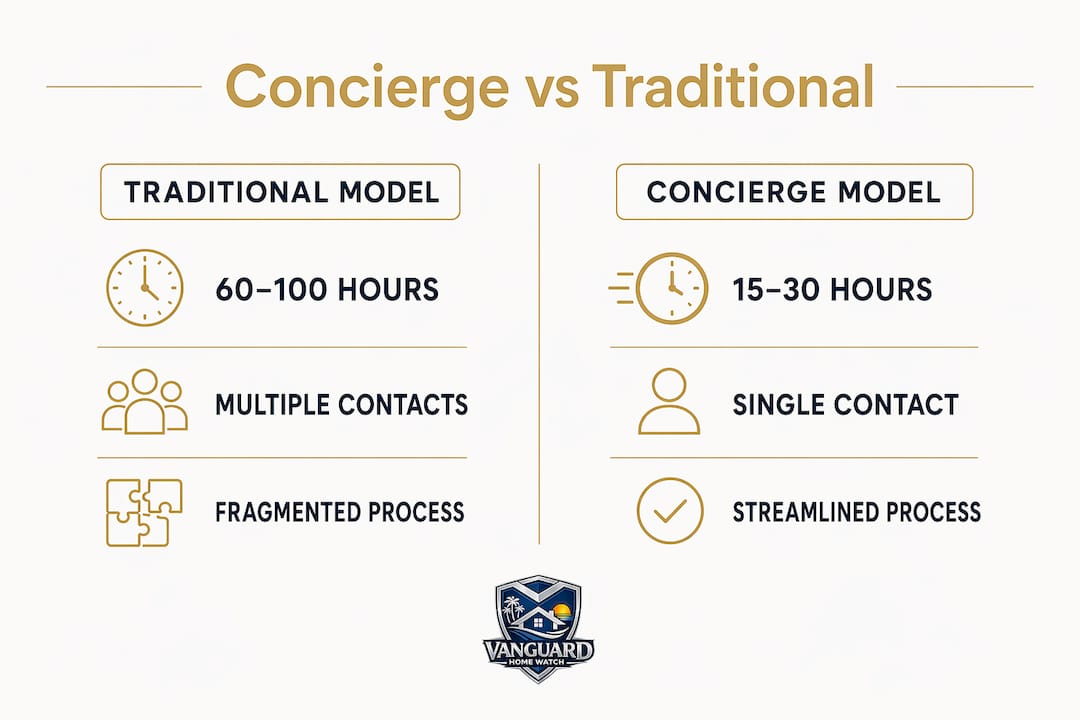
The concierge model reduces client involvement time dramatically. Client time investment drops from 60–100 hours in a traditional transaction to 15–30 hours under a concierge model. That is a reduction of 70–80% in operational hours, which frees the client to focus on strategic decisions rather than logistics.
The mechanism behind this reduction is the single point of contact. Instead of coordinating separately with an agent, attorney, contractor, stager, and bank, the client communicates with one advisor who manages all of those relationships. Concierge advisors act as project managers, handling communications with notaries, attorneys, banks, and contractors on the client’s behalf. That consolidation eliminates the scheduling conflicts, missed calls, and duplicated effort that make traditional transactions exhausting.
| Factor | Traditional model | Concierge model |
|---|---|---|
| Client hours required | 60–100 hours | 15–30 hours |
| Points of contact | 5–10 separate vendors | 1 concierge advisor |
| Process documentation | Client-managed | Checklists and roadmaps provided |
| Stress level | High, fragmented | Low, guided |
| Post-closing support | Minimal | Ongoing |
Proactive communication through checklists, move preparation guides, and detailed roadmaps gives clients a clear picture of what happens next at every stage. That clarity is the primary driver of stress reduction. Clients who know what to expect, and who to call when something changes, report significantly higher confidence throughout the transaction.
Pro Tip: Request a written process roadmap from any concierge provider before signing an agreement. A provider who cannot produce a documented workflow is likely managing your transaction reactively rather than proactively.
Why are concierge services especially valuable in luxury real estate?
Luxury real estate transactions are structurally more complex than standard residential deals. The target transaction range for concierge programs is $800,000 to $5 million, a segment where the financial stakes, legal complexity, and client expectations all demand a higher level of coordination. A missed inspection, a delayed closing document, or a poorly staged property can cost tens of thousands of dollars in a market where price per square foot is already elevated.
Concierge programs deliver measurable returns in this segment. Effective concierge programs yield increased sale prices, shortened market time, and cost efficiencies through established vendor relationships. Those outcomes are not incidental. They result directly from the preparation, coordination, and quality control that a concierge model provides.
The specific advantages in the luxury segment include:
- Estate appraisals and specialized valuations coordinated with certified appraisers who understand high-value asset classes
- Auction and off-market transaction support for properties that do not follow standard listing timelines
- Interior design and staging at scale for large properties where presentation drives buyer perception
- Discreet, private transaction management for clients who require confidentiality
- Long-term relationship management that extends well beyond the closing date
High-touch concierge services build client trust and generate referrals by staying engaged long after the transaction closes. In the luxury market, referrals from satisfied clients are the primary growth engine for any service provider. That makes the concierge model a business strategy, not just a client amenity.
For owners of luxury properties in Naples, the concierge model extends naturally into ongoing property oversight. A home worth $2 million requires consistent, documented care whether the owner is present or not.
How do real estate concierge services coordinate among professionals?
Coordination is the operational core of any concierge program. Concierge services integrate legal, financial, technical, and service vendor specialists into one cohesive process managed by a single advisor. Without that integration, each specialist operates in isolation, creating gaps where critical tasks fall through.
The coordination challenge in a luxury transaction is significant. A typical closing involves a real estate attorney, a title company, a mortgage lender, a home inspector, a stager, and at least two or three contractors. Each has their own timeline, communication style, and set of dependencies. A concierge advisor maps those dependencies, builds an integrated calendar, and manages each relationship so the client never has to chase a contractor or remind an attorney about a deadline.
| Coordination area | Traditional model | Concierge model |
|---|---|---|
| Legal and financial scheduling | Client coordinates directly | Advisor manages all appointments |
| Contractor oversight | Client sources and supervises | Advisor uses vetted vendor network |
| Inspection and repair follow-up | Client tracks independently | Advisor monitors and reports |
| Communication between parties | Fragmented, client-managed | Centralized through one contact |
Vendor sourcing and management for contractors, painters, cleaners, landscapers, and interior designers through vetted professional networks is a defining feature of the concierge model. A vetted network means the advisor has already verified licensing, insurance, and quality of work. The client benefits from that vetting without doing any of it themselves.
For absentee owners, managing contractors remotely is one of the most common pain points in property ownership. A concierge advisor eliminates that friction by serving as the on-the-ground point of contact for every vendor interaction. The client receives updates, photos, and completion confirmations without needing to be present.
Key Takeaways
Real estate concierge service is the most effective model for reducing client time, managing transaction complexity, and protecting asset value in luxury property transactions.
| Point | Details |
|---|---|
| Full-spectrum service scope | Concierge programs cover staging, vendor management, legal coordination, and post-closing support. |
| Dramatic time savings | Client involvement drops from 60–100 hours to 15–30 hours under a concierge model. |
| Luxury market advantage | Transactions in the $800,000 to $5 million range benefit most from structured concierge coordination. |
| Single point of contact | One advisor manages all vendors, attorneys, and contractors, eliminating fragmented communication. |
| Long-term value | Concierge relationships extend beyond closing to ongoing property management and referral generation. |
What I’ve learned about concierge services after years in property management
Most people think of concierge service as a luxury add-on. After years working in property management and home watch services in Naples, I see it differently. Concierge service is risk management. Every hour a client spends chasing a contractor or waiting on a closing document is an hour where something can go wrong. The concierge model eliminates that exposure.
What I have observed consistently is that clients who engage a concierge provider early in the process, before listing or before closing, experience fewer surprises. The preparation phase is where most transaction problems originate. A pre-listing inspection that catches a plumbing issue saves weeks of renegotiation after a buyer’s inspector finds the same problem. A concierge advisor who schedules that inspection as a standard step prevents the problem before it becomes a crisis.
The other thing I would tell anyone evaluating concierge services: ask about what happens after closing. That is where the real value separates good providers from great ones. Long-term property oversight for a seasonal or vacant home is not a secondary service. For an absentee owner, it is the primary service. The transaction ends at closing. The property does not.
Selecting a concierge provider is a trust decision. Look for documented processes, verified vendor relationships, and a provider who communicates proactively rather than reactively. Those three criteria will tell you more about a provider’s reliability than any marketing material.
— Joseph
Vanguard Home Watch LLC: concierge-level care for Naples homeowners
Owners of high-value homes in Naples, North Naples, and Ave Maria know that property care does not stop at closing. Vanguard Home Watch LLC delivers the same structured, documented oversight that defines the concierge model, applied specifically to vacant and seasonal home management.

Every Vanguard Home Watch LLC visit includes a detailed digital report with photos, covering HVAC performance, water intrusion, humidity levels, pest activity, and security concerns. Our team is fully insured, bonded, background checked, and accredited by the National Home Watch Association (NHWA). Founded by retired law enforcement lieutenant Joseph Vangelakos and real estate professional Elizabeth Vangelakos, we bring both security expertise and property knowledge to every inspection. Learn how our home watch service frequency options protect your investment year-round. Contact us to schedule a consultation.
FAQ
What is a real estate concierge service?
A real estate concierge service is a full-service model where one advisor manages all logistical, preparatory, and transitional tasks in a property transaction, from staging and vendor coordination to post-closing support, so the client focuses on decisions rather than details.
What does a concierge do in real estate transactions?
A real estate concierge coordinates staging, renovation management, legal appointments, contractor oversight, and post-closing transitions, acting as a single point of contact for every professional involved in the transaction.
How does a real estate concierge service reduce stress?
Proactive communication through checklists, roadmaps, and a single contact point eliminates the fragmented coordination that makes traditional transactions stressful, reducing client involvement from 60–100 hours to 15–30 hours.
Are real estate concierge services only for luxury buyers?
Concierge services are most common in the $800,000 to $5 million transaction range, but the model applies to any property where the owner values time savings, professional coordination, and post-closing support over managing the process independently.
Do concierge services cost extra beyond standard brokerage fees?
Concierge services are often included within brokerage models rather than charged as separate fees, and the increased sale prices and cost efficiencies they generate typically outweigh any implied additional cost.

