If you own a seasonal home in Florida or travel for extended periods, understanding the difference between home watch and house sitting could save you from a costly mistake. These two arrangements sound similar, but they operate on completely different models of care, accountability, and professional responsibility. Choosing the wrong one for your situation means the wrong level of protection for your property. This guide breaks down exactly what each service involves, where they diverge, and how to decide which approach fits your needs.
Table of Contents
- Key Takeaways
- The difference between home watch and house sitting, defined
- What professional home watch services actually do
- What house sitters do and how the arrangement works
- Home watch vs. house sitting: a direct comparison
- Choosing the right option for your situation
- How documentation sets home watch apart
- My honest take on where owners go wrong
- Protect your Naples home with professional home watch
- FAQ
Key Takeaways
| Point | Details |
|---|---|
| Different service models | Home watch is a professional inspection service; house sitting is a trust-based live-in arrangement. |
| Documentation matters | Professional home watch provides time-stamped, photo-documented reports that house sitting cannot replicate. |
| Pet care changes priorities | House sitting is often the stronger choice when pets are present and daily routines must be maintained. |
| Insurance and accreditation | Home watch providers carry formal insurance and bonding; house sitters typically do not. |
| Complementary, not competing | Both services have distinct strengths and can be used together depending on the property and owner’s needs. |
The difference between home watch and house sitting, defined
The phrase “home watch” has a specific industry meaning. The National Home Watch Association defines it as a visual inspection of a home or property looking for obvious issues. A licensed, insured home watch professional visits your vacant property on a scheduled basis, checks for problems, and delivers a documented report to you. No one lives there. The focus is entirely on early detection and risk mitigation.
House sitting, by contrast, is a trust-based arrangement. A house sitter physically stays in your home, rent-free, in exchange for taking care of the property and often your pets. The protection comes from continuous human presence, not from formal inspection protocols.
Here is where homeowners get tripped up: both involve someone looking after your home while you are away, but the structure, accountability, and scope of each service are fundamentally different. Treating them as interchangeable is how problems start.
What professional home watch services actually do
Home watch is a scheduled, professional service. A trained and accredited provider visits your property at regular intervals, typically weekly, and conducts a thorough visual inspection of the interior and exterior. The provider is bonded, insured, and background-checked. Every visit generates a report.
A typical home watch inspection covers:
- HVAC operation and thermostat settings
- Visible plumbing and signs of water intrusion
- Humidity and mold-prone areas
- Pest activity and entry points
- Appliance function and unusual odors
- Exterior condition after storms or high winds
- Security of doors, windows, and locks
- Pool area and landscaping concerns
Vacant homes face significant hidden risks, including slow plumbing leaks behind walls and appliance failures that go undetected for weeks. Early detection is the entire point. Home watch should be understood as an early-warning system that complements your security system and maintenance schedule. It does not replace either.
Pro Tip: When evaluating home watch providers, verify NHWA accreditation, active insurance, and bonding before signing any agreement. Homeowners often overlook this step, and it is the single most important protection against liability if something goes wrong on your property.
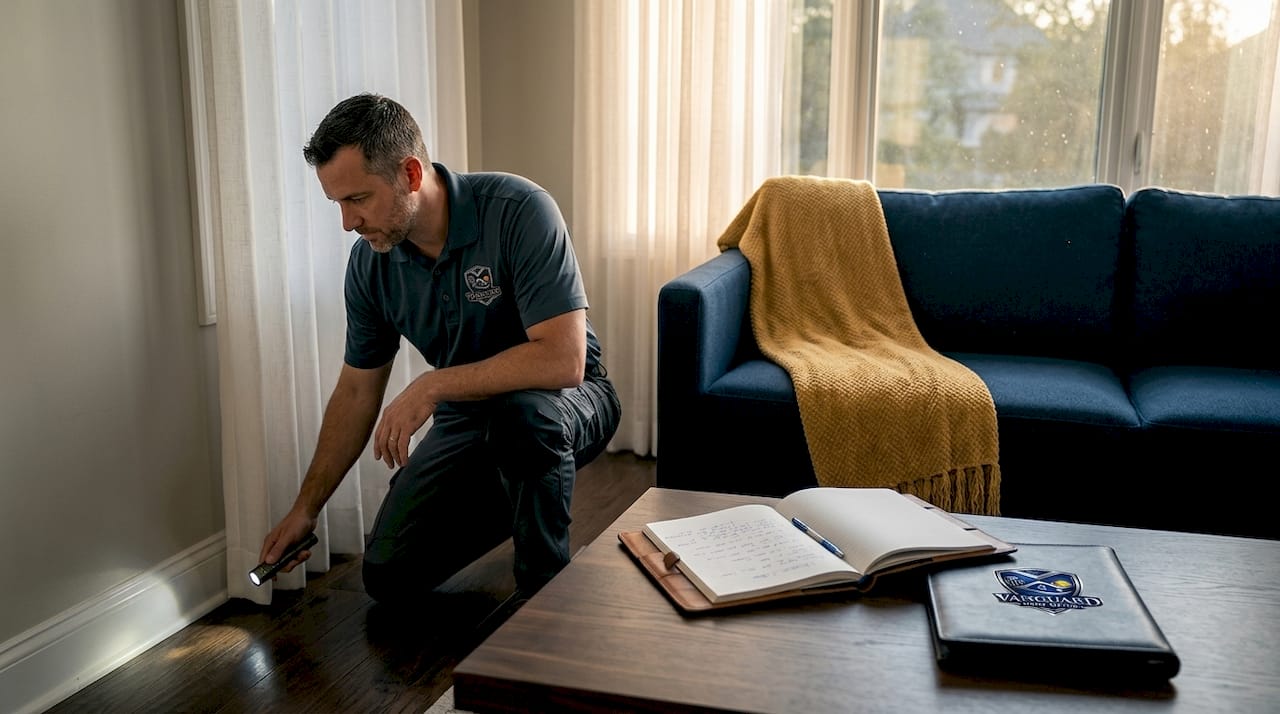
Professional home watch services also maintain secure key handling procedures and GPS-verified visit logs, which provide a defensible record for insurance claims and real estate disclosures.
What house sitters do and how the arrangement works
House sitting is a different proposition entirely. A house sitter moves into your home temporarily and lives there throughout your absence. In exchange for free lodging, they handle day-to-day responsibilities. House sitter duties typically include pet care, mail collection, basic home upkeep, and maintaining a visible security presence.
Pet care is often the primary driver. Many house sits prioritize animal well-being above all else, meaning the sitter’s schedule centers around feeding, walking, medication, and companionship for your pets rather than formal property inspections.
Other common responsibilities include:
- Collecting mail and packages
- Watering plants and managing basic yard care
- Running appliances to prevent seals from drying out
- Reporting visible problems to the homeowner
The arrangement relies heavily on mutual trust and clear communication. There is no standardized reporting format, no time-stamped photo log, and no professional liability insurance protecting you if the sitter causes accidental damage. Some homeowners hire paid sitters; others use exchange platforms where sitters receive free accommodation in return for their services.
Pro Tip: Before any house sitter enters your home, put the agreement in writing. Clear formal agreements should specify duties, access limits, guest policies, pet care instructions, and what to do in an emergency. A handshake arrangement is not enough.
Home watch vs. house sitting: a direct comparison
Understanding where these services converge and where they split apart makes the decision much cleaner. Here is a side-by-side look at the key differences.
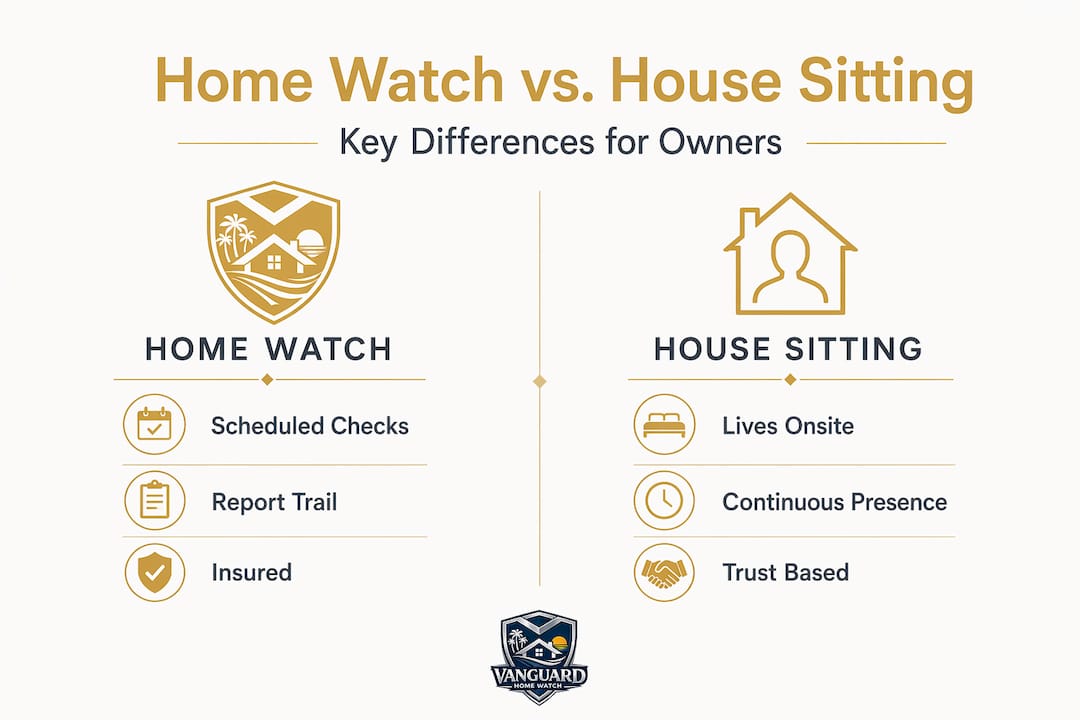
| Factor | Home Watch | House Sitting |
|---|---|---|
| Occupancy | No one lives in the home | Sitter lives in the home |
| Service frequency | Scheduled visits (weekly or as agreed) | Continuous presence |
| Primary focus | Risk detection and documentation | Daily care and presence |
| Accountability structure | Professional, insured, contracted | Trust-based, informal or semi-formal |
| Documented reports | Yes, with photos and timestamps | Typically no formal reporting |
| Insurance and bonding | Required for accredited providers | Rarely applicable |
| Pet care | Not included | Often the central responsibility |
| Best use case | Vacant seasonal homes, investment properties | Homes with pets, longer absences |
Home watch emphasizes risk mitigation and generating an evidence trail. House sitting emphasizes continuous care and maintaining the feel of an occupied home. These services are genuinely complementary rather than competing options. Some homeowners use both, arranging a house sitter for pet care while keeping a home watch provider on retainer for professional inspections and documentation.
The trust base differs significantly. Home watch is contractual and professional. If something goes wrong, there is a paper trail, an insured provider, and a documented timeline. House sitting depends on the personal relationship between owner and sitter, with all the vulnerability that implies.
Choosing the right option for your situation
Neither arrangement is universally better. The right choice depends on your property, your absence length, and what you need most while you are away.
Consider these factors in order:
- Do you have pets? If yes, house sitting is almost certainly necessary. A professional home watch provider does not care for animals. You may still want to add a home watch service for formal documentation, but the pet care piece requires a live-in sitter.
- How long will you be away? Short seasonal absences of a few weeks to a few months are the sweet spot for professional home watch services. Longer absences, especially a year or more, may benefit from the presence a house sitter provides in addition to formal inspections.
- Does your insurance require documented visits? Many homeowner insurance policies on vacant properties require proof of regular inspections. A house sitter’s presence does not satisfy that requirement. You need documented home watch reports to stay compliant.
- What is your comfort level with strangers in your home? House sitting requires allowing someone to live in your space, use your appliances, and access your belongings. For some owners, that level of access feels manageable. For others, it does not. Home watch visits are scheduled, bounded, and documented.
- What is the property’s risk profile? Homes in humid climates like Southwest Florida face specific seasonal risks from humidity, mold, and storm activity that require trained eyes, not just an occupied home.
Pro Tip: If you are hiring a home watch company, ask whether they are NHWA accredited, whether they carry general liability insurance, and how they handle emergencies after hours. Those three questions separate professional providers from informal arrangements that carry the same name.
How documentation sets home watch apart
One of the clearest practical differences between home watch and house sitting is what you receive after each visit. With professional home watch, you get a digital report after every inspection. That report includes photos, timestamps, GPS verification, and notes on anything observed. Formal providers conduct time-stamped, photo-documented inspections covering HVAC, plumbing, and exterior conditions.
That documentation matters in several specific situations:
- Insurance claims: A photo-documented report showing the condition of your HVAC system or roof before a storm is a powerful piece of evidence during a claims dispute.
- Real estate transactions: Buyers and agents want property condition records that demonstrate consistent care and early intervention on maintenance issues.
- Legal defense: If a dispute arises over when damage occurred, GPS-verified visit logs provide a clear timeline.
- Insurance compliance: Many policies on unoccupied homes require proof of regular professional inspections to remain valid.
House sitting offers none of this. The value of a house sitter is presence and care. The limitation is the absence of any formal record. Technology can fill some gaps. Smart home devices, cameras, and remote monitoring systems complement both services. But they do not replace the documented, professional inspection that home watch providers deliver.
My honest take on where owners go wrong
I have worked with absentee homeowners and seasonal residents for years, and the confusion I see most often is not about the services themselves. It is about what people assume those services include.
Owners sometimes hire a house sitter and assume they have covered their property’s risk exposure. They have not. A sitter living in the home may notice an obvious leak, but they will not check the water heater for scale buildup, inspect the attic for humidity intrusion, or document the HVAC runtime. That is not what they were hired to do.
On the other side, I see owners who sign up for home watch and assume someone is watching their home around the clock. They are not. Home watch visits are scheduled and purposeful, not continuous surveillance. The value is in trained eyes reviewing specific systems on a regular schedule and generating records that protect you.
What I have learned is that the right question is not “which service is better?” It is “what does my property actually need?” A Naples seasonal home sitting empty from May through October, in high humidity, with no pets, needs formal weekly inspections and documented reports far more than it needs someone living there. A home with three dogs and a garden needs a house sitter first, with home watch added as a second layer.
Do not let the names mislead you. Ask what the service delivers, what is documented, who is accountable, and what happens if something goes wrong at 2 a.m. on a Sunday.
— Joseph
Protect your Naples home with professional home watch
If your property spends months unoccupied each year, professional home watch is not optional. It is the layer of protection that everything else depends on.

At Vanguard Home Watch LLC, we provide weekly visual inspections for vacant and seasonal homes across Naples, North Naples, and Ave Maria. Every visit includes a detailed digital report with photos delivered straight to you. We are fully insured, bonded, background checked, and NHWA accredited. Founded by retired law enforcement lieutenant Joseph Vangelakos and real estate professional Elizabeth Vangelakos, our service is owner-operated and personally accountable. Explore the benefits for seasonal owners or reach out directly to schedule your first inspection. Your home deserves more than a good-faith arrangement.
FAQ
What is the main difference between home watch and house sitting?
Home watch is a professional inspection service where a licensed, insured provider visits a vacant property on a scheduled basis and delivers documented reports. House sitting is a trust-based live-in arrangement where a person stays in the home in exchange for daily care duties.
Does house sitting replace professional home watch?
No. House sitting and home watch serve different purposes. A house sitter provides continuous presence and often pet care, but does not generate the documented inspection reports that many insurance policies and real estate transactions require.
Can I use both services at the same time?
Yes. Many homeowners pair a house sitter for pet care and daily routines with a home watch provider for formal, documented inspections. The two services address different needs and work well together.
What does a home watch provider check during each visit?
A professional home watch provider visually inspects HVAC systems, plumbing, humidity levels, pest activity, appliance operation, exterior condition, and all entry points. Every visit produces a photo-documented report with timestamps.
Do I need home watch if my vacation home is in Florida?
Florida’s climate makes professional home watch especially important. High humidity, mold risk, and seasonal storms create conditions that require trained, regular inspections to catch problems before they become expensive repairs.

