If you own a luxury property in Naples or anywhere in Southwest Florida and spend part of the year away, you’ve likely wondered what’s actually happening to your home while you’re gone. A luxury home watch service explained properly is not a neighbor checking your mail or a handyman stopping by occasionally. It is a professional, scheduled inspection program, formally known in the industry as home watch, designed to monitor vacant or seasonally occupied properties with precision and accountability. This article covers what the service includes, why it matters for high-end homes, how it compares to other options, and what to look for when choosing a trusted provider.
Table of Contents
- Key Takeaways
- Luxury home watch service explained: what it actually is
- Benefits that matter to luxury homeowners
- Home watch vs. property management and other services
- How to choose the right provider
- Integrating home watch into your seasonal routine
- My honest take on what makes this service worth it
- Protect your Naples property with Vanguard Home Watch
- FAQ
Key Takeaways
| Point | Details |
|---|---|
| Home watch is a professional service | It involves scheduled visual inspections with documented reports, not casual property checks. |
| Early detection protects luxury assets | Catching issues like HVAC failures or water leaks early prevents costly, often irreversible damage. |
| It differs from property management | Home watch is inspection-focused; property management handles tenants, finances, and leasing. |
| NHWA accreditation matters | Choosing a certified provider signals verified professionalism and adherence to industry standards. |
| Reports support insurance and resale | Time-stamped photo documentation creates a verifiable record useful in claims and transactions. |
Luxury home watch service explained: what it actually is
The National Home Watch Association defines home watch as “a visual inspection of a home or property, looking for obvious issues.” That definition is precise on purpose. A professional home watch provider does not repair, manage tenants, or collect rent. The job is to show up on a regular schedule, look carefully, document everything, and report back to you with clarity and speed.
For a luxury property, that scope carries real weight. Your home in a gated Naples community may sit vacant for four, five, or six months at a stretch. During that time, Florida’s climate does not slow down. Humidity builds. HVAC systems fail without warning. Roof seals loosen after storm activity. Pests find entry points. A water line can leak for weeks before anyone notices, and by then the damage to hardwood floors, cabinetry, and custom finishes can run into tens of thousands of dollars.
A professional home watch inspection typically covers:
- Interior walkthrough: checking for moisture, mold indicators, pest intrusion, and any visible water damage
- HVAC system: confirming the system is running within normal parameters and that filters and drainage lines are clear
- Plumbing: running water and inspecting under sinks, around toilets, and near water heaters for leaks or pressure issues
- Appliances: verifying refrigerators, dishwashers, and built-in units are functioning correctly
- Exterior condition: examining the roof, windows, doors, pool equipment, and landscaping for storm damage or security concerns
- Security systems: confirming alarm systems are active, entry points are secure, and no signs of unauthorized access exist
The contrast with a casual check is significant. Structured, documented oversight for luxury homes includes time-stamped photo reports and archived condition reviews, not a quick walk-through with no written record.
Pro Tip: Ask any prospective provider to share a sample inspection report before you commit. A reputable home watch company will have detailed, photo-backed documentation that reads like a professional property condition summary, not a handwritten note.
Benefits that matter to luxury homeowners
The value of consistent professional oversight goes well beyond “someone checks in.” For absentee and seasonal owners, the practical benefits of home watch connect directly to protecting a significant financial and personal asset.
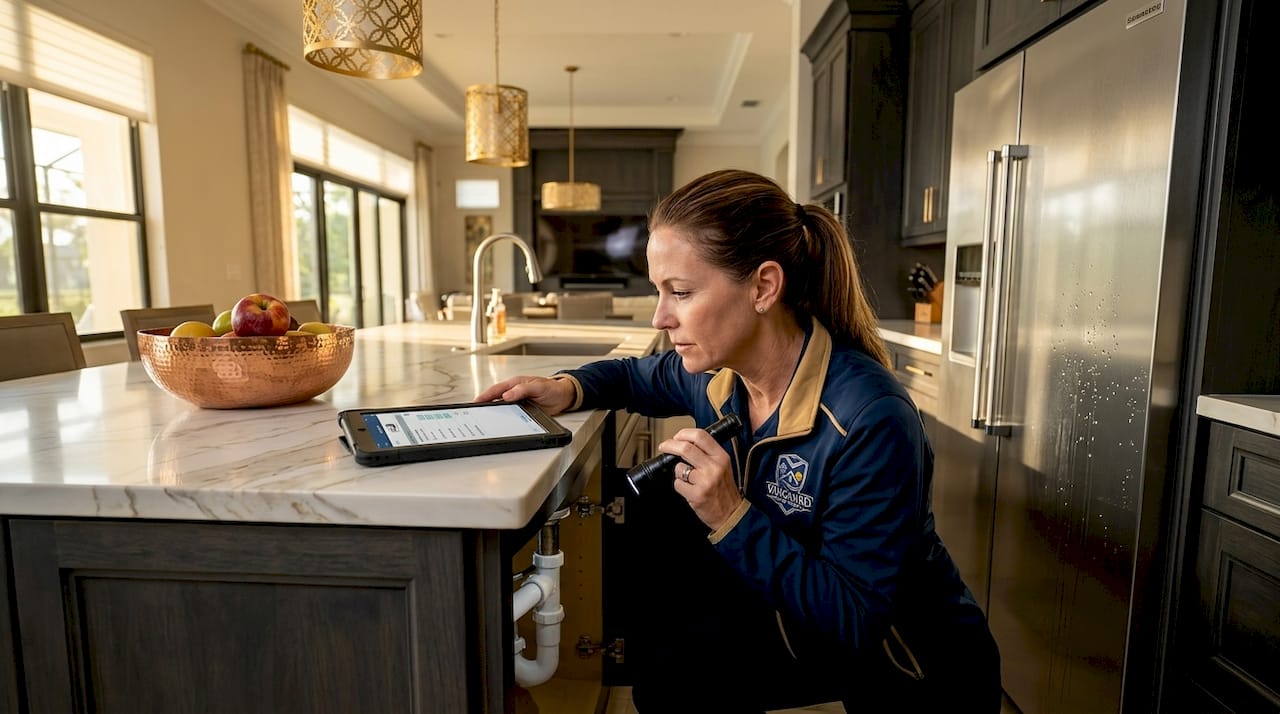
Peace of mind is the most immediate return. Knowing that a trusted professional is walking through your property each week, with eyes trained to spot trouble early, allows you to be fully present wherever you are. That is not a small thing when your home represents one of your largest investments.
Early detection is where the real financial case lives. A slow leak under a kitchen sink, caught in week one, costs almost nothing to fix. Caught in week eight, after it has saturated subfloor material and begun growing mold beneath custom cabinetry, that same problem can cost $30,000 or more to remediate in a luxury home. The math is straightforward.
Documentation and reporting provide a record that insurance companies and real estate professionals take seriously. Verified home condition records carry weight in property transactions and can support insurance claims when you need to prove what happened and when.
Many premium home watch services also offer concierge-style add-ons, including pre-arrival preparation, post-departure checks, vendor coordination, and storm preparation. Concierge services tailored for Naples-area homeowners can include stocking the home before your arrival, coordinating with housekeepers, and managing trades during your absence.
“The difference between a minor repair and a major catastrophe is often just time. Regular, documented inspections are the single most reliable way to keep that window short.”
Home watch vs. property management and other services
This is where confusion is most common. Property management and home watch sound similar but serve very different purposes. Understanding the distinction helps you choose the right level of service for your situation.
Property management is designed for income-producing properties. A property manager handles tenant placement, lease agreements, rent collection, maintenance coordination, and legal compliance. Their focus is on the property as a business asset. Fees typically range from 8 to 12 percent of monthly rental income, and the relationship is built around active occupancy.
Home watch is designed for vacant or seasonally occupied properties. The focus is condition monitoring, not financial management. A home watch provider visits on a scheduled basis, inspects and documents, and alerts you to anything that needs attention. Fees are typically charged as a flat monthly or per-visit rate, well below property management costs, and there is no income-producing activity involved.
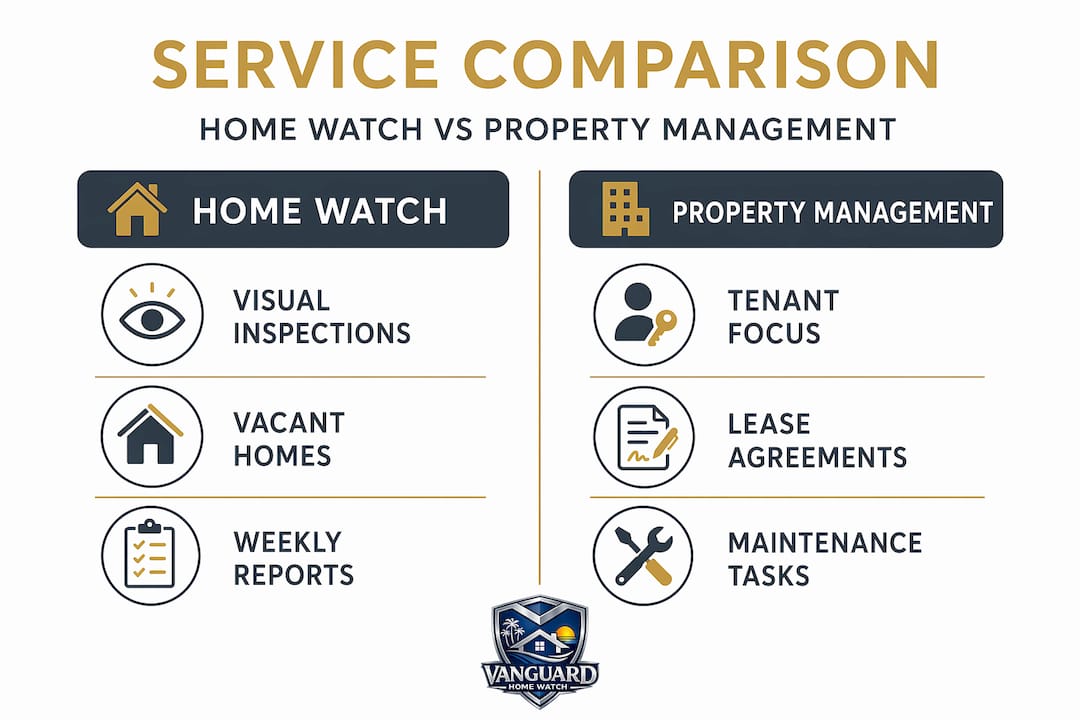
| Feature | Home Watch | Property Management |
|---|---|---|
| Primary focus | Condition inspections and reporting | Tenant management and income |
| Typical use case | Vacant or seasonal homes | Rental or income properties |
| Reporting format | Photo reports after each visit | Monthly financial statements |
| Tenant coordination | None | Core function |
| Concierge services | Often included | Rarely included |
| Average cost | Flat per-visit or monthly fee | 8 to 12% of rental income |
Some owners also consider security monitoring companies or property managers with inspection add-ons as alternatives. Neither fully replicates what a dedicated home watch professional provides. Security systems detect intrusions but cannot identify a dripping pipe behind a wall. Property managers focused on tenants do not prioritize the condition-based documentation that protects luxury properties in gated Naples communities.
Pro Tip: If your property is seasonal and vacant for any part of the year, home watch and property management are not competing services. They answer different questions. One asks “Is someone paying rent?” and the other asks “Is your home still in perfect condition?”
How to choose the right provider
Not all home watch companies are equal, and for a luxury property, the stakes are high enough that your evaluation process should be deliberate.
- Verify NHWA accreditation. The National Home Watch Association certifies providers who meet professional standards for training, ethics, and business practices. NHWA membership signals that a company has been vetted, not just self-described as professional.
- Confirm insurance and bonding. Your provider should carry general liability insurance and be bonded. Ask for certificates of coverage, not just verbal assurances. You are giving someone regular access to your home.
- Review their reporting format. A qualified provider delivers detailed digital reports with time-stamped photographs after every inspection. If a company cannot show you what their reports look like, that is a serious concern.
- Assess local expertise. A provider who knows regional risks specific to South Florida, including hurricane season protocols, high-humidity mold conditions, and local utility systems, will catch problems that an outsider might miss entirely.
- Ask about emergency response. What happens if something urgent is found during an inspection? Your provider should have a clear protocol: immediate notification, a vetted vendor network, and the ability to coordinate a response without waiting for your approval on every step.
Pro Tip: Choose an owner-operated service over a large franchise when possible. When the owner’s name is on the door, you get direct accountability on every visit. You are not relying on a rotating staff of hourly employees.
Integrating home watch into your seasonal routine
Once you select a provider, getting the most from the service comes down to coordination and communication. Here is how to set it up for maximum effectiveness.
- Set a weekly inspection schedule. For properties vacant during Florida’s summer months, weekly visits are the standard. Humidity, storm activity, and the risk of pest intrusion all accelerate in the off-season. Monthly visits are not sufficient for vacant luxury homes in South Florida.
- Share your vendor contacts upfront. Give your home watch provider the contact information for your HVAC technician, plumber, electrician, and any other regular service vendors. When an issue is found, the response can begin immediately.
- Use reports for insurance documentation. Store every inspection report in a dedicated folder. If a storm event or appliance failure leads to a claim, dated photo reports showing the property’s prior condition are exactly what adjusters need. Home watch reports carry real weight in real estate transactions for the same reason.
- Schedule pre-arrival and post-departure checks. A concierge-style pre-arrival visit can confirm the home is clean, cool, stocked, and ready before you land. A post-departure check confirms everything was properly secured after you leave.
- Communicate seasonal concerns. If you know that a section of your roof had minor storm damage last season, or that your pool equipment has been temperamental, document that for your provider. They will pay closer attention where it matters.
My honest take on what makes this service worth it
I have been in and around law enforcement and property care for my entire career. When Elizabeth and I founded Vanguard Home Watch LLC, I had already seen, firsthand, what happens to unmonitored properties. Not occasionally. Regularly.
The most common thing I hear from new clients is some version of “I didn’t think I really needed this.” They have a neighbor with a key, or an alarm system, or a property manager who promised to “keep an eye on things.” What I have learned is that none of those arrangements produce documented, scheduled, professional inspections. A neighbor is not going to run the faucets and check beneath the sinks. An alarm company is not going to notice that your air handler drain line is blocked and your unit is about to shut down from overflow.
What I have also seen is the aftermath when those gaps matter. Water damage that started as a small supply line drip and turned into a full floor replacement. Mold behind a bathroom vanity that had been growing silently for three months. A back door with a compromised lock that sat that way all summer.
The homeowners who avoided those outcomes had one thing in common: someone was showing up every week with a trained eye and a responsibility to document and report. That is what professional home watch actually provides. Not a safety net. A system.
— Joseph
Protect your Naples property with Vanguard Home Watch
At Vanguard Home Watch LLC, we provide weekly visual inspections for vacant and seasonal luxury homes throughout Naples, North Naples, and Ave Maria. Every visit includes a detailed digital report with photographs delivered directly to you, so you always know exactly what is happening at your property. We are fully insured, bonded, background-checked, and accredited members of the National Home Watch Association.
Founded and personally operated by Joseph and Elizabeth Vangelakos, we bring law enforcement discipline and real estate expertise to every inspection. There are no subcontractors. No rotating staff. When you work with us, you know who is walking through your home.
If you are ready to protect your luxury property with a trusted home watch service built specifically for Naples-area absentee and seasonal homeowners, we invite you to reach out for a consultation. You can also learn more about how to hire the right home watch company in Naples before you make your decision.
FAQ
What does a luxury home watch service include?
A luxury home watch service includes scheduled visual inspections of the interior and exterior of a vacant or seasonally occupied home, covering HVAC, plumbing, appliances, security, and overall condition, followed by a detailed photo report delivered to the owner after each visit.
How is home watch different from property management?
Home watch focuses on property condition monitoring through regular inspections and documentation for vacant homes, while property management handles tenant relations, leasing, and financial oversight for income-producing properties. The two serve different purposes and are not interchangeable.
Why does NHWA accreditation matter when choosing a provider?
NHWA-certified providers have been vetted against professional standards for training, ethics, and business practices, giving homeowners a reliable way to confirm a provider’s legitimacy beyond self-promotion.
How often should my vacant home be inspected?
For luxury homes vacant during Florida’s summer season, weekly inspections are the recognized standard. Humidity levels, storm activity, and the speed at which undetected water damage escalates all make less frequent visits a significant risk for high-value properties.
Can home watch reports be used for insurance claims?
Yes. Time-stamped photo documentation from regular inspections creates a verifiable record of your home’s condition before and after any event, which insurance adjusters and real estate professionals can reference during claims or transactions.

